

 Next


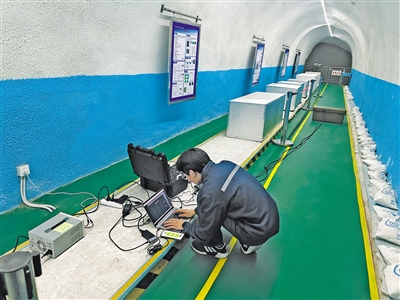 |
| At the Taishan Deep Earth Laboratory, a Ph.D. student is calibrating an unshielded SERF atomic magnetometer. (PHOTO: XINHUA) |
 |
China will accelerate scaled and industrialized innovative application of artificial intelligence (AI) in the natural resources sector, supporting the intelligent upgrading of the "One Map" for territorial spatial planning.
The Ministry of Natural Resources and the National Development and Reform Commission issued a guide on "AI + Natural Resources," setting out phased development goals.
By 2028, the natural resources sector will be achieved demonstration applications of AI, and the intelligence level of the "One Map" will be comprehensively elevated.
By 2030, AI will be deeply integrated into the entire chain of natural resource management, and an integrated intelligent platform for territorial spatial governance will be built.
The guide proposes coordinating the layout of five AI pilot testing platforms covering spatiotemporal geographic information, territorial spatial planning and governance, oceans, geology and mineral resources, and forestry and grassland. The goal is to create a service system that integrates computing power supply, model training, algorithm iteration, scenario validation and ecosystem building.
Eight demonstration application scenarios in natural resources have been rolled out, covering AI plus integrated "sky-ground-sea-network" monitoring and supervision, territorial spatial planning and governance, natural resource asset management, and natural resource disaster governance.
To meet prevention and control needs for typical disasters such as geological hazards, marine disasters, and forest and grassland fires, an intelligent perception system will be built, and intelligent monitoring and early warning models developed.
In marine resource development and governance, the focus is on deep-sea and polar exploration, marine resource development and marine environmental protection. Breakthroughs will be made in the intelligent screening of marine compounds, and AI-empowered marine environmental forecasting models. R&D of autonomous and controllable marine intelligent equipment will be prioritized to form new AI+ capabilities serving marine energy, pharmaceuticals, shipping, and tourism.
An "AI Super Brain" for earth sciences will be built. Early warning technologies for key processes of the Earth system will be developed focusing on lithosphere, hydrosphere, atmosphere, and biosphere.