
 Next


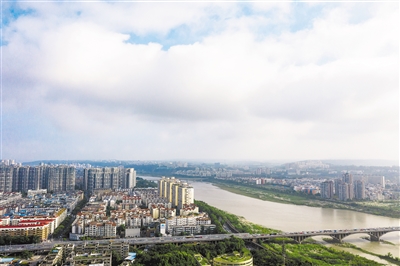 |
| China (Mianyang) Science and Technology City in Sichuan province. (PHOTO: VCG) |
At a nuclear technology application conference held in Mianyang city, Sichuan province in southwest China, in September, the Sichuan Province National Defense Science and Technology Industry Office released a series of documents on the high-quality development of nuclear technology and industry, proposing that the province's nuclear industry scale will exceed 200 billion RMB by 2030.
As the core of Sichuan's nuclear medicine industry, Mianyang has built a complete industrial chain spanning medical isotope production, radiopharmaceutical R&D, nuclear medicine equipment manufacturing, and clinical application.
Currently, the city hosts five chain-leader enterprises, 26 chain-affiliated enterprises, 17 national high-tech enterprises and technology-based small and medium-sized enterprises, and 15 industrial enterprises above designated size.
Leveraging a cluster of research institutes
Mianyang's greatest advantage in developing the nuclear medicine industry lies in its deep technical accumulation from research institutes and laboratories.
Compact Boron Neutron Capture Therapy (BNCT) is hailed as the "crown jewel" of radiotherapy, distinguished by its precise targeting and minimally invasive safety. At the Nuclear Medicine Health Industrial Park of China (Mianyang) Science and Technology City, the assembly and commissioning of China's first BNCT system is underway, with a market launch planned for 2028.
Last December, China General Nuclear Power Corporation's medical isotope production base in Mianyang was completed and entered trial production.The base has achieved scaled production of multiple key medical isotopes, including germanium-68, and now is focusing on the industrialization of copper-64 and zirconium-89.
In nuclide production, Mianyang has developed full industrial-chain capabilities for the research, production and application of isotopes, covering reactors, accelerators and generators, and has built five reactor-based nuclide production lines enabling stable, independent and large supply of six reactor-produced isotopes, including iodine-131, lutetium-177 and molybdenum-99.
As for nuclear medicine equipment, Mianyang has become the only domestic leading hub for all four types of radiation used to treat tumors — protons, electrons, photons and neutrons.
From R&D to application
At the workshop of a technology company in the city, a medical radiation-protection glove is under production. With a fingertip thickness of just 0.12 millimeters, the glove enables doctors to block radiation without compromising fine manipulation.
It entered Sichuan's special review and approval procedure for innovative medical devices in August.
This glove is an example of research outcomes moving from the laboratories of scientific institutes to the production line.
Mianyang operates a working mechanism of "one industrial chain, one chain-leader enterprise, one chief scientist, one dedicated work team and one set of support policies," bringing all parties to the same table — research institutes supply technology, manufacturers handle implementation, industrial platforms coordinate capital and resources, and hospitals communicate clinical needs in advance.
The city has also established nine industrial investment funds to steer social capital toward early-stage, small-scale, long-term and hard-tech investment.
A high-quality construction project for nuclear medicine diagnosis and treatment was recently launched at Mianyang Central Hospital. Mianyang Sanjiang Hospital, a Grade III, Class A general hospital with a focus on nuclear medical care, has also officially started operation.
With sustained collaboration between R&D, manufacturing and clinical practice, Mianyang is set to accelerate its rise as a globally influential nuclear medicine health industry hub.