
 Next
Next


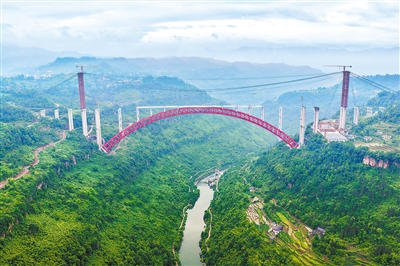 |
| The Fenglai Daxi River Grand Bridge under construction in southwest China's Chongqing. (PHOTO: XINHUA) |
High above a deep gorge in southwest China's Chongqing, the final concrete deck panel of a bridge was lowered into place with millimeter precision. On June 12, the steel-concrete composite girder of the Fenglai Daxi River Grand Bridge was officially completed. With a main span of 580 meters, it is now the world's largest-span steel arch bridge.
Standing over a deeply incised tributary of the Wujiang River, the bridge is both an engineering marvel and a dialogue across 1,400 years — blending the ancient wisdom of the Zhaozhou Bridge, a stone arch bridge built 1,400 years ago, with modern digital technology.
Why an arch bridge?
"This is a typical deep V-shaped gorge with limited space, huge height differences and fierce valley winds," explained Chen Kejian, deputy chief engineer of China Railway Eryuan Engineering Group. Suspension and cable-stayed bridges need towering pylons, which would be extremely difficult to erect here and costly. Arch bridges offer rational force distribution and the V-shaped cliffs in the area serve as natural abutments. A disadvantage thus became an advantage.
The first challenge was sheer weight: 25,800 tonnes of steel, equivalent to 3.6 Eiffel Towers. Traditional solid abutments would crush the load-bearing foundation.
The design team drew inspiration from the Zhaozhou Bridge. Its pioneering "open-spandrel" design reduced weight by hollowing out the spandrels. The team adapted this into an "inverted π-shaped" hollow foundation, standing on two "legs" to distribute pressure.
The 580-meter span also introduced a new mechanical problem: lateral forces. Traditional small-span arch bridges are controlled mainly by vertical forces, but here the arch foot is controlled by both lateral and vertical forces.
"We broke convention and, for the first time globally, adopted active control of arch ring internal forces using cables," said Zhang Chao, project design lead. This transferred pressure from the lower chord to the upper chord, solving the anchoring problem and cutting steel consumption by 37 percent compared with similar bridges of smaller span.
Digital 'twin' fixes pre-assembly
The second challenge was pre-assembly. Hundreds of thousands of high-strength bolts had to pass through holes with only a three-millimeter gap. "It's like assembling hundreds of tonnes of Lego at 100 meters high and threading hundreds of thousands of screws through needle eyes," said Huang Jian, technical lead at China Railway No. 8 Engineering Group.
Worse, the only pre-assembly yard was less than 90 meters of usable length. Multi-round assembly would cause errors to snowball, potentially leading to deviations of over 10 centimeters.
Professor Zhou Jianting's team at Chongqing Jiaotong University provided the key: digital pre-assembly. Each steel component is "CT-scanned" with holographic laser scanning, and the point cloud data are stitched into a millimeter-precision 3D "virtual twin."
"A single truss segment is 18 meters high, 39.5 meters long, and weighs 425 tonnes. We control bolt hole reconstruction within one millimeter and overall segment accuracy within two millimeters," said Zhou Yin, deputy director of the university's large-span arch bridge intelligent construction institute. Unlike ordinary building information modeling, this is a "force-form coupled" dynamic simulation that calculates deformation during assembly.
The team also developed "N+1 pre-assembly control technology," locking errors into the manufacturing stage. This cut pre-assembly time by 25 percent and raised full-arch alignment from centimeter to millimeter precision.
A dynamic 'brain' for high-altitude assembly
The third challenge: cantilever assembling 10,000 tonnes of steel at 310 meters high, amid gorge winds and 20-centimeter temperature deformation between day and night.
"The steel arch expands tens of centimeters in the sun and contracts at night," Huang said. "With a fully bolted structure, a one-millimeter deviation in the first segment could lead to centimeter-level errors later."
The team deployed an "original shape reset installation control method" and a "digital twin control platform." The reset method gives each suspended segment a 3D millimeter-level target, so it fits "right the first time." The twin platform captures every deformation in real time and predicts invisible internal forces, ensuring adjustments when the sun or wind is present.
The system improved high-altitude alignment efficiency by 50 percent. "The pass rate for high-strength bolts and first-time weld inspection both exceed 99.5 percent," Huang said.
The project has produced more than 10 innovative technologies, including active control design, stress-free closure, digital pre-assembly, and environment-adaptive installation — clearing key obstacles for assembled construction of long-span arch bridges in mountainous regions.
With the girder joined, the bridge has entered its final sprint. This red arc across the Daxi River Gorge is both a tribute to ancient bridge engineering and a powerful calling card for China's infrastructure.