
 Next
Next


 |
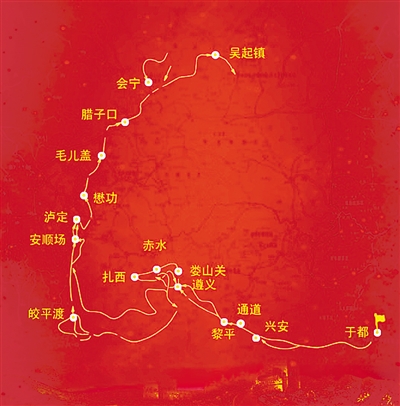 |
| A map shows the routes taken during the Long March. (PHOTO: China Military Online) |
Twelve thousand five hundred kilometers. Two years. Over 206,000 soldiers across all Chinese Red Army units set out, but only just over 57,000 arrived.
These figures may seem remote and lifeless but the story behind them is not. It is a story of firm belief and courage that feared no sacrifice, of strict discipline and solidarity.
In October 1934, the main forces of the Chinese Red Army found themselves encircled in their base areas in Jiangxi province in east China. The forces surrounding them were far larger, and there was no realistic prospect of breaking through by remaining where they were. The Red Army then moved to break the Kuomintang's siege and continue the fight against Japanese invaders. What followed became known as the Long March.
Over the next two years, the Red Army crossed raging rivers, climbed snow-capped mountains, and traversed vast grasslands, fighting their way through repeated attempts to block and destroy them. The march lasted from October 1934 to October 1936. Some units covered as far as 12,500 kilometers, the longest distance marched by any unit.
Along the way, the Red Army fought hundreds of engagements. In late 1934, the Central Red Army suffered their heaviest loss in a single battle at the Xiangjiang River in south China, where their numbers were cut by more than half. In May 1935, to secure a path over the turbulent Dadu River in the southwest, soldiers crossed the Luding Bridge even though the enemy had removed the wooden planks of the bridge, by crawling across its iron chains with grim determination. In September 1935, they scaled sheer cliffs to capture the Lazikou Pass in the northwest, opening the road north.
In January 1935, a meeting in the town of Zunyi corrected the military approach that had led to earlier defeats and set a new direction. The Zunyi Meeting is regarded as a turning point during the Long March and a key event in the success of the Chinese revolution. From that point on, the march became not merely a matter of survival but a purposeful advance northward, toward the front lines of resistance against Japanese invasion. This direction was progressively defined in the months that followed and culminated in the establishment of "moving north to resist Japanese aggression."
American journalist Edgar Snow, the first Western reporter to reach the Communist base areas, interviewed Red Army personnel, including Long March participants, in 1936. In the book Red Star Over China (1937), he sought to capture what the Long March meant, not as a military operation, but as a human experience: "Adventure, exploration, discovery, human courage and cowardice, ecstasy and triumph, suffering, sacrifice, and loyalty, and then through it all, like a flame, an undimmed ardor and undying hope and amazing revolutionary optimism of those thousands of youths who would not admit defeat by man or nature of God or death - all this and more seemed embodied in the history of an odyssey unequaled in modern times."
Snow's account reached a global audience. For many readers outside China, it was the first real evidence that the Communist movement was not the spent force its enemies claimed. It was something far more resilient, and, in Snow's telling, undeniably human. The Long March entered the world's imagination as a story of survival, resolve and endurance that could not be ignored.
Ninety years later, the Long March endures, not merely as a chapter in military history but as a record of what human beings can endure when driven by firm belief. The soldiers who walked those roads were mostly young people, many in their teens and 20s. They had no motorized transport, no air cover, no reliable supply lines. Yet against all odds, they completed the march victoriously under the leadership of the Communist Party of China.
That is why, nine decades on, it continues to resonate far beyond the borders of China.