


 |
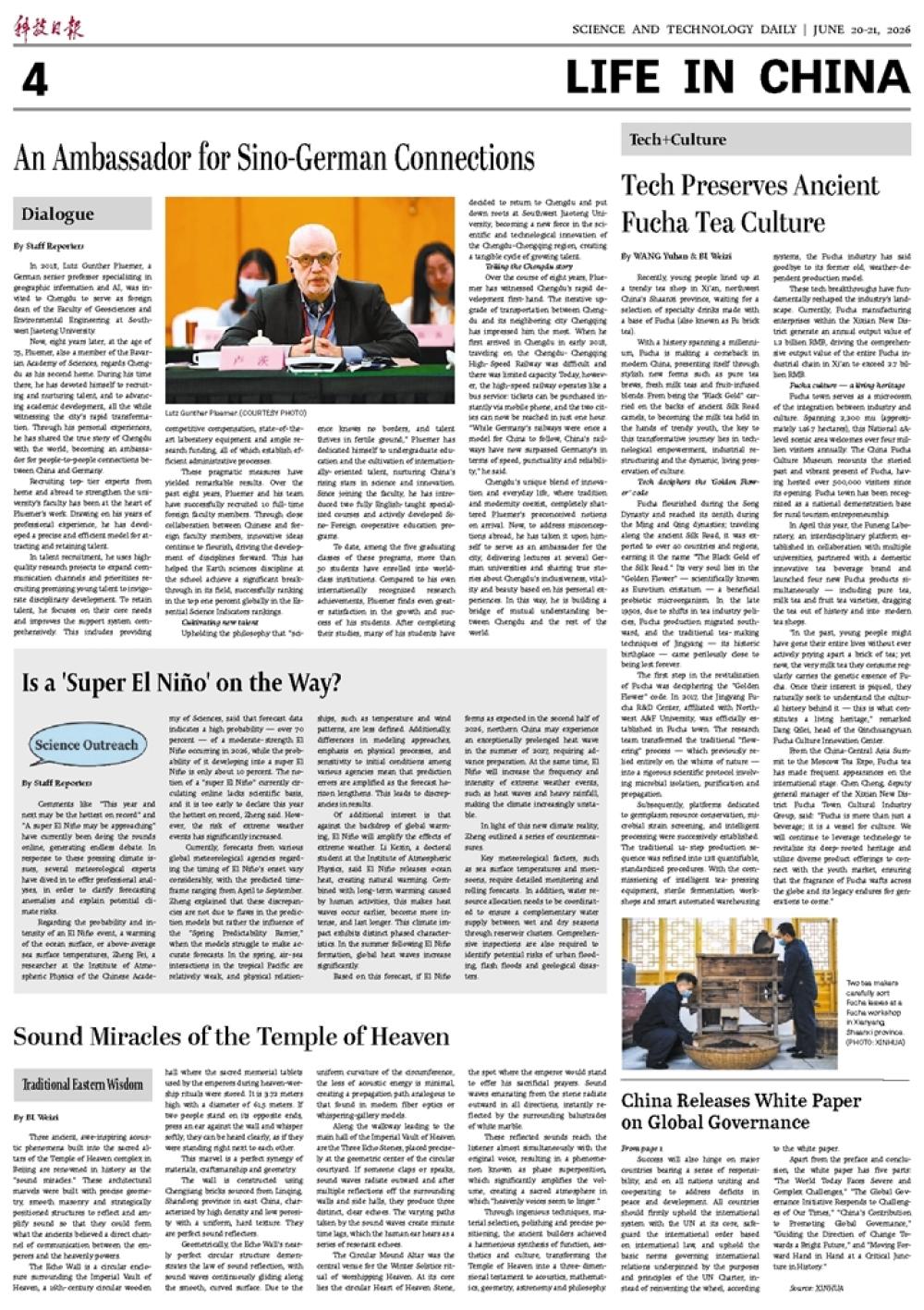
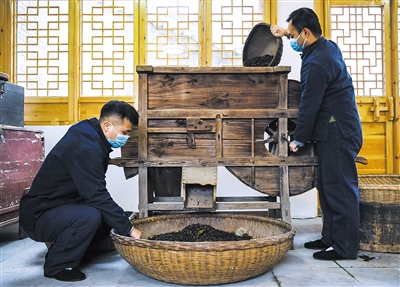
| Two tea makers carefully sort Fucha leaves at a Fucha workshop in Xianyang, Shaanxi province. (PHOTO: XINHUA) |
Recently, young people lined up at a trendy tea shop in Xi'an, northwest China's Shaanxi province, waiting for a selection of specialty drinks made with a base of Fucha (also known as Fu brick tea).
With a history spanning a millennium, Fucha is making a comeback in modern China, presenting itself through stylish new forms such as pure tea brews, fresh milk teas and fruit-infused blends. From being the "Black Gold" carried on the backs of ancient Silk Road camels, to becoming the milk tea held in the hands of trendy youth, the key to this transformative journey lies in technological empowerment, industrial restructuring and the dynamic, living preservation of culture.
Tech deciphers the 'Golden Flower' code
Fucha flourished during the Song Dynasty and reached its zenith during the Ming and Qing dynasties; traveling along the ancient Silk Road, it was exported to over 40 countries and regions, earning it the name "The Black Gold of the Silk Road." Its very soul lies in the "Golden Flower" — scientifically known as Eurotium cristatum — a beneficial probiotic microorganism. In the late 1950s, due to shifts in tea industry policies, Fucha production migrated southward, and the traditional tea-making techniques of Jingyang — its historic birthplace — came perilously close to being lost forever.
The first step in the revitalization of Fucha was deciphering the "Golden Flower" code. In 2017, the Jingyang Fucha R&D Center, affiliated with Northwest A&F University, was officially established in Fucha town. The research team transformed the traditional "flowering" process — which previously relied entirely on the whims of nature — into a rigorous scientific protocol involving microbial isolation, purification and propagation.
Subsequently, platforms dedicated to germplasm resource conservation, microbial strain screening, and intelligent processing were successively established. The traditional 14-step production sequence was refined into 128 quantifiable, standardized procedures. With the commissioning of intelligent tea-pressing equipment, sterile fermentation workshops and smart automated warehousing systems, the Fucha industry has said goodbye to its former old, weather-dependent production model.
These tech breakthroughs have fundamentally reshaped the industry's landscape. Currently, Fucha manufacturing enterprises within the Xixian New District generate an annual output value of 1.2 billion RMB, driving the comprehensive output value of the entire Fucha industrial chain in Xi'an to exceed 2.7 billion RMB.
Fucha culture — a living heritage
Fucha town serves as a microcosm of the integration between industry and culture. Spanning 2,200 mu (approximately 146.7 hectares), this National 4A-level scenic area welcomes over four million visitors annually. The China Fucha Culture Museum recounts the storied past and vibrant present of Fucha, having hosted over 500,000 visitors since its opening. Fucha town has been recognized as a national demonstration base for rural tourism entrepreneurship.
In April this year, the Funeng Laboratory, an interdisciplinary platform established in collaboration with multiple universities, partnered with a domestic innovative tea beverage brand and launched four new Fucha products simultaneously — including pure tea, milk tea and fruit tea varieties, dragging the tea out of history and into modern tea shops.
"In the past, young people might have gone their entire lives without ever actively prying apart a brick of tea; yet now, the very milk tea they consume regularly carries the genetic essence of Fucha. Once their interest is piqued, they naturally seek to understand the cultural history behind it — this is what constitutes a living heritage," remarked Dang Qilei, head of the Qinchuangyuan Fucha Culture Innovation Center.
From the China-Central Asia Summit to the Moscow Tea Expo, Fucha tea has made frequent appearances on the international stage. Chen Chong, deputy general manager of the Xixian New District Fucha Town Cultural Industry Group, said: "Fucha is more than just a beverage; it is a vessel for culture. We will continue to leverage technology to revitalize its deep-rooted heritage and utilize diverse product offerings to connect with the youth market, ensuring that the fragrance of Fucha wafts across the globe and its legacy endures for generations to come."