

 Next
Next


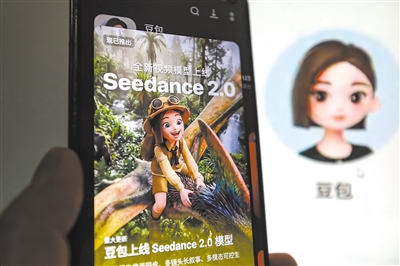 |
| AI video generation model Seedance 2.0 is developed by Chinese tech firm ByteDance. (PHOTO: VCG) |
The Financial Times (FT) recently reported that Chinese AI tech companies have moved ahead of U.S. rivals in video generation. By highlighting ByteDance's Seedance 2.0 and Kuaishou's Kling, the report said that their models now produce more realistic, stable and controllable videos, driving rapid commercial adoption, in comparison with their Western competitors.
The FT said the shift marks a divergence in the AI race: while OpenAI, Google and Anthropic lead in large language models and areas, their video tools are falling behind Chinese alternatives in both quality and usability.
Seedance 2.0 made international headlines with its February upgrade, hailed for outstanding performance of generating cinema-quality videos. "Many industry experts and filmmakers believe Seedance is a new chapter in the development of video-generating technology," BBC reported at the time.
AI ethics researcher Margaret Mitchell told BBC that it stands out by integrating text, visuals and audio into a single system. The complex action sequences it is producing look more realistic than its competitors, David Kwok, who runs a Singapore-based animation studio, told BBC.
"Seedance 2.0 is one of the most well-rounded video generation models I've tested so far. It genuinely surprised me by delivering satisfying results on the first try, even with a simple prompt," Hugging Face's Yakefu told CNBC, adding that it demonstrates enhanced controllability, speed and production efficiency.
Besides Seedance 2.0, other Chinese AI video tools like Kling and HappyHorse 1.0 are now the definitive world-building engines, as proved by multiple usage leader boards.
In early April, Alibaba's HappyHorse-1.0 climbed to the top of blind-test rankings for both text-to-video and image-to-video generation on the benchmarking platform Artificial Analysis.
According to Stanford University's AI Index Report 2026, Chinese models captured eight out of the top 10 places in the authoritative VBench-2.0 ranking.
Why is China leading in AI video generation?
Vast volumes of proprietary video data are one of the important factors. "ByteDance and Kuaishou operate some of the world's largest short-video platforms, giving them a training advantage that is difficult for competitors to replicate," the FT reported.
Furthermore, it could be attributed to China's overall strength in AI competition. Mohit Kumar, Jefferies global macro strategist, told Fortune that China has emerged as the major victor in the AI race due to its "valuation, wider adoption of AI, [and] an advantage in power generation."
Computing power, data center infrastructure and energy can constrain a nation's AI capabilities, and China already outpaces the U.S. in energy production and transmission, Ellen Zentner, chief economic strategist and global head of Thematic and Macro Investing at Morgan Stanley, said in an analysis report.
Where Western entertainment industries are hesitant to use AI, China's micro-drama industry has embraced mass commercial application of AI-generated video.
"China has demonstrated repeatedly that it can match or exceed Western AI capabilities at a fraction of the cost, and the micro-drama industry is the most commercially visible example of that principle, applied to content creation at industrial scale," new-tech platform The Next Web reported.