

 Next
Next


 |
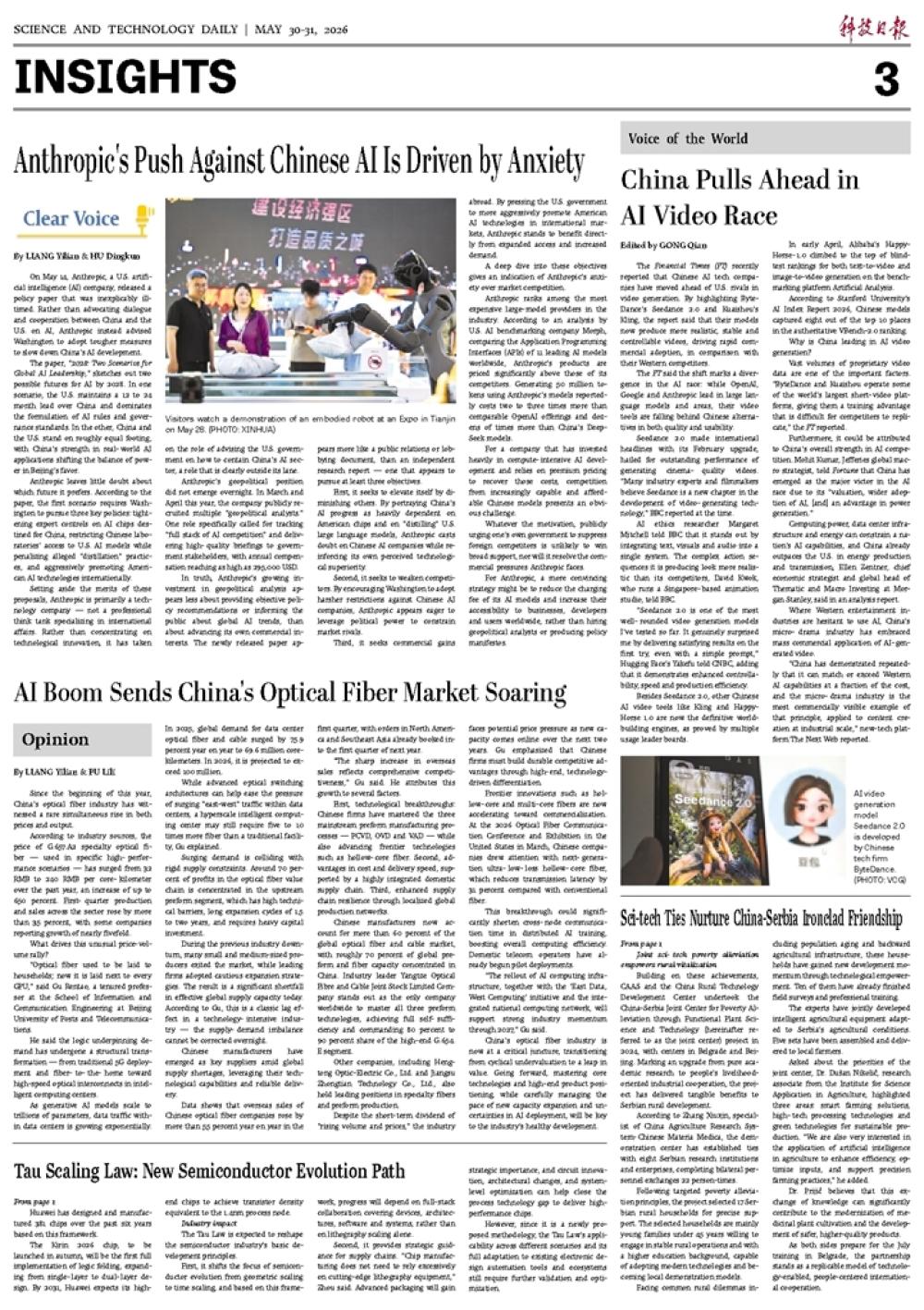
| Visitors watch a demonstration of an embodied robot at an Expo in Tianjin on May 28. (PHOTO: XINHUA) |
On May 14, Anthropic, a U.S. artificial intelligence (AI) company, released a policy paper that was inexplicably ill-timed. Rather than advocating dialogue and cooperation between China and the U.S. on AI, Anthropic instead advised Washington to adopt tougher measures to slow down China's AI development.
The paper, "2028: Two Scenarios for Global AI Leadership," sketches out two possible futures for AI by 2028. In one scenario, the U.S. maintains a 12 to 24 month lead over China and dominates the formulation of AI rules and governance standards. In the other, China and the U.S. stand on roughly equal footing, with China's strength in real-world AI applications shifting the balance of power in Beijing's favor.
Anthropic leaves little doubt about which future it prefers. According to the paper, the first scenario requires Washington to pursue three key policies: tightening export controls on AI chips destined for China, restricting Chinese laboratories' access to U.S. AI models while penalizing alleged "distillation" practices, and aggressively promoting American AI technologies internationally.
Setting aside the merits of these proposals, Anthropic is primarily a technology company — not a professional think tank specializing in international affairs. Rather than concentrating on technological innovation, it has taken on the role of advising the U.S. government on how to contain China's AI sector, a role that is clearly outside its lane.
Anthropic's geopolitical position did not emerge overnight. In March and April this year, the company publicly recruited multiple "geopolitical analysts." One role specifically called for tracking "full stack of AI competition" and delivering high-quality briefings to government stakeholders, with annual compensation reaching as high as 295,000 USD.
In truth, Anthropic's growing investment in geopolitical analysis appears less about providing objective policy recommendations or informing the public about global AI trends, than about advancing its own commercial interests. The newly released paper appears more like a public relations or lobbying document, than an independent research report — one that appears to pursue at least three objectives.
First, it seeks to elevate itself by diminishing others. By portraying China's AI progress as heavily dependent on American chips and on "distilling" U.S. large language models, Anthropic casts doubt on Chinese AI companies while reinforcing its own perceived technological superiority.
Second, it seeks to weaken competitors. By encouraging Washington to adopt harsher restrictions against Chinese AI companies, Anthropic appears eager to leverage political power to constrain market rivals.
Third, it seeks commercial gains abroad. By pressing the U.S. government to more aggressively promote American AI technologies in international markets, Anthropic stands to benefit directly from expanded access and increased demand.
A deep dive into these objectives gives an indication of Anthropic's anxiety over market competition.
Anthropic ranks among the most expensive large-model providers in the industry. According to an analysis by U.S. AI benchmarking company Morph, comparing the Application Programming Interfaces (APIs) of 11 leading AI models worldwide, Anthropic's products are priced significantly above those of its competitors. Generating 50 million tokens using Anthropic's models reportedly costs two to three times more than comparable OpenAI offerings and dozens of times more than China's DeepSeek models.
For a company that has invested heavily in compute-intensive AI development and relies on premium pricing to recover those costs, competition from increasingly capable and affordable Chinese models presents an obvious challenge.
Whatever the motivation, publicly urging one's own government to suppress foreign competitors is unlikely to win broad support, nor will it resolve the commercial pressures Anthropic faces.
For Anthropic, a more convincing strategy might be to reduce the charging fee of its AI models and increase their accessibility to businesses, developers and users worldwide, rather than hiring geopolitical analysts or producing policy manifestos.