


 |
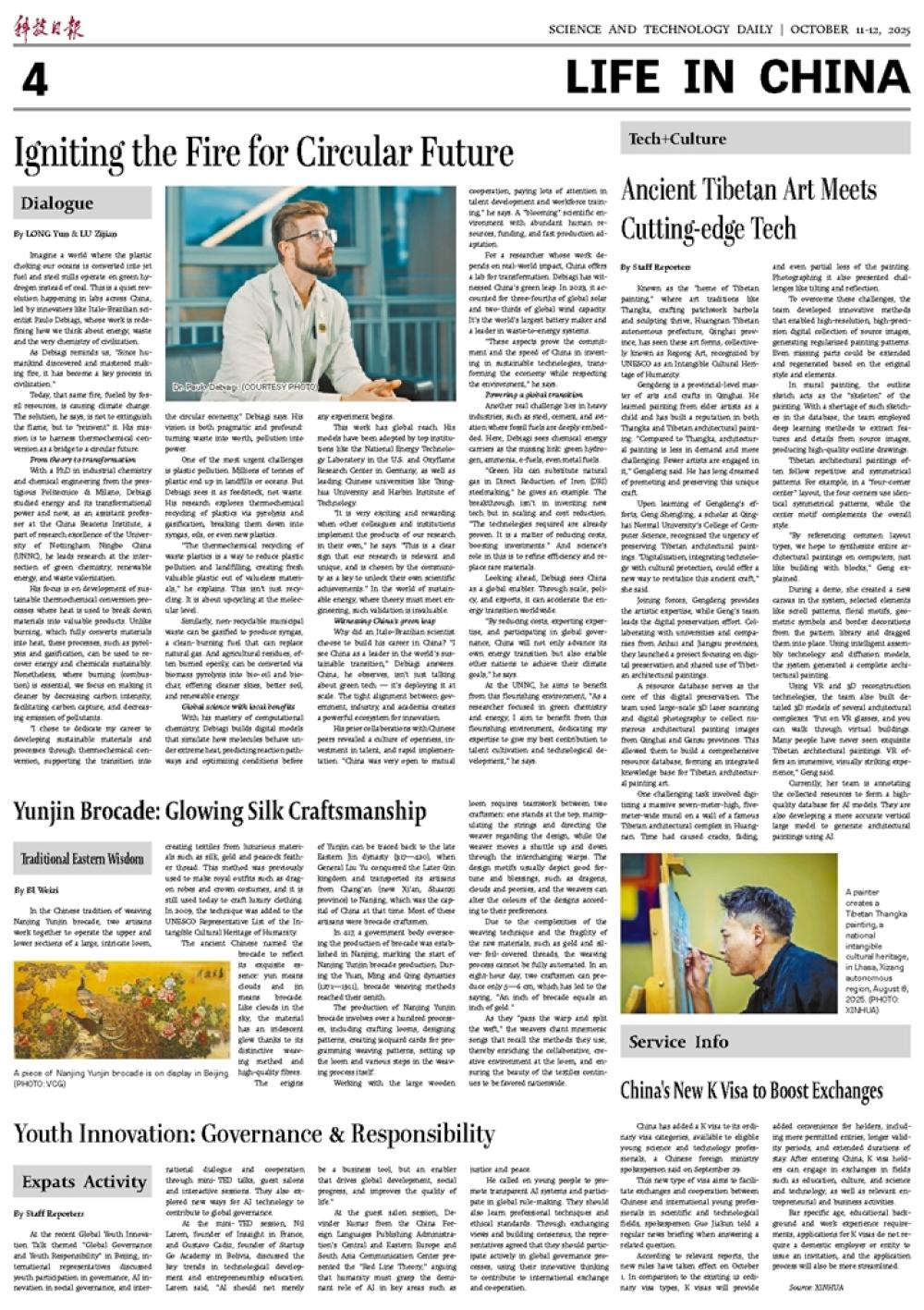
| A painter creates a Tibetan Thangka painting, a national intangible cultural heritage, in Lhasa, Xizang autonomous region, August 6, 2025. (PHOTO: XINHUA) |
Known as the "home of Tibetan painting," where art traditions like Thangka, crafting patchwork barbola and sculpting thrive, Huangnan Tibetan autonomous prefecture, Qinghai province, has seen these art forms, collectively known as Regong Art, recognized by UNESCO as an Intangible Cultural Heritage of Humanity.
Gengdeng is a provincial-level master of arts and crafts in Qinghai. He learned painting from elder artists as a child and has built a reputation in both Thangka and Tibetan architectural painting. "Compared to Thangka, architectural painting is less in demand and more challenging. Fewer artists are engaged in it," Gengdeng said. He has long dreamed of promoting and preserving this unique craft.
Upon learning of Gengdeng's efforts, Geng Shengling, a scholar at Qinghai Normal University's College of Computer Science, recognized the urgency of preserving Tibetan architectural paintings. "Digitalization, integrating technology with cultural protection, could offer a new way to revitalize this ancient craft," she said.
Joining forces, Gengdeng provides the artistic expertise, while Geng's team leads the digital preservation effort. Collaborating with universities and companies from Anhui and Jiangsu provinces, they launched a project focusing on digital preservation and shared use of Tibetan architectural paintings.
A resource database serves as the core of this digital preservation. The team used large-scale 3D laser scanning and digital photography to collect numerous architectural painting images from Qinghai and Gansu provinces. This allowed them to build a comprehensive resource database, forming an integrated knowledge base for Tibetan architectural painting art.
One challenging task involved digitizing a massive seven-meter-high, five-meter-wide mural on a wall of a famous Tibetan architectural complex in Huangnan. Time had caused cracks, fading, and even partial loss of the painting. Photographing it also presented challenges like tilting and reflection.
To overcome these challenges, the team developed innovative methods that enabled high-resolution, high-precision digital collection of source images, generating regularized painting patterns. Even missing parts could be extended and regenerated based on the original style and elements.
In mural painting, the outline sketch acts as the "skeleton" of the painting. With a shortage of such sketches in the database, the team employed deep learning methods to extract features and details from source images, producing high-quality outline drawings.
Tibetan architectural paintings often follow repetitive and symmetrical patterns. For example, in a "four-corner center" layout, the four corners use identical symmetrical patterns, while the center motif complements the overall style.
"By referencing common layout types, we hope to synthesize entire architectural paintings on computers, just like building with blocks," Geng explained.
During a demo, she created a new canvas in the system, selected elements like scroll patterns, floral motifs, geometric symbols and border decorations from the pattern library and dragged them into place. Using intelligent assembly technology and diffusion models, the system generated a complete architectural painting.
Using VR and 3D reconstruction technologies, the team also built detailed 3D models of several architectural complexes. "Put on VR glasses, and you can walk through virtual buildings. Many people have never seen exquisite Tibetan architectural paintings. VR offers an immersive, visually striking experience," Geng said.
Currently, her team is annotating the collected resources to form a high-quality database for AI models. They are also developing a more accurate vertical large model to generate architectural paintings using AI.