


 |
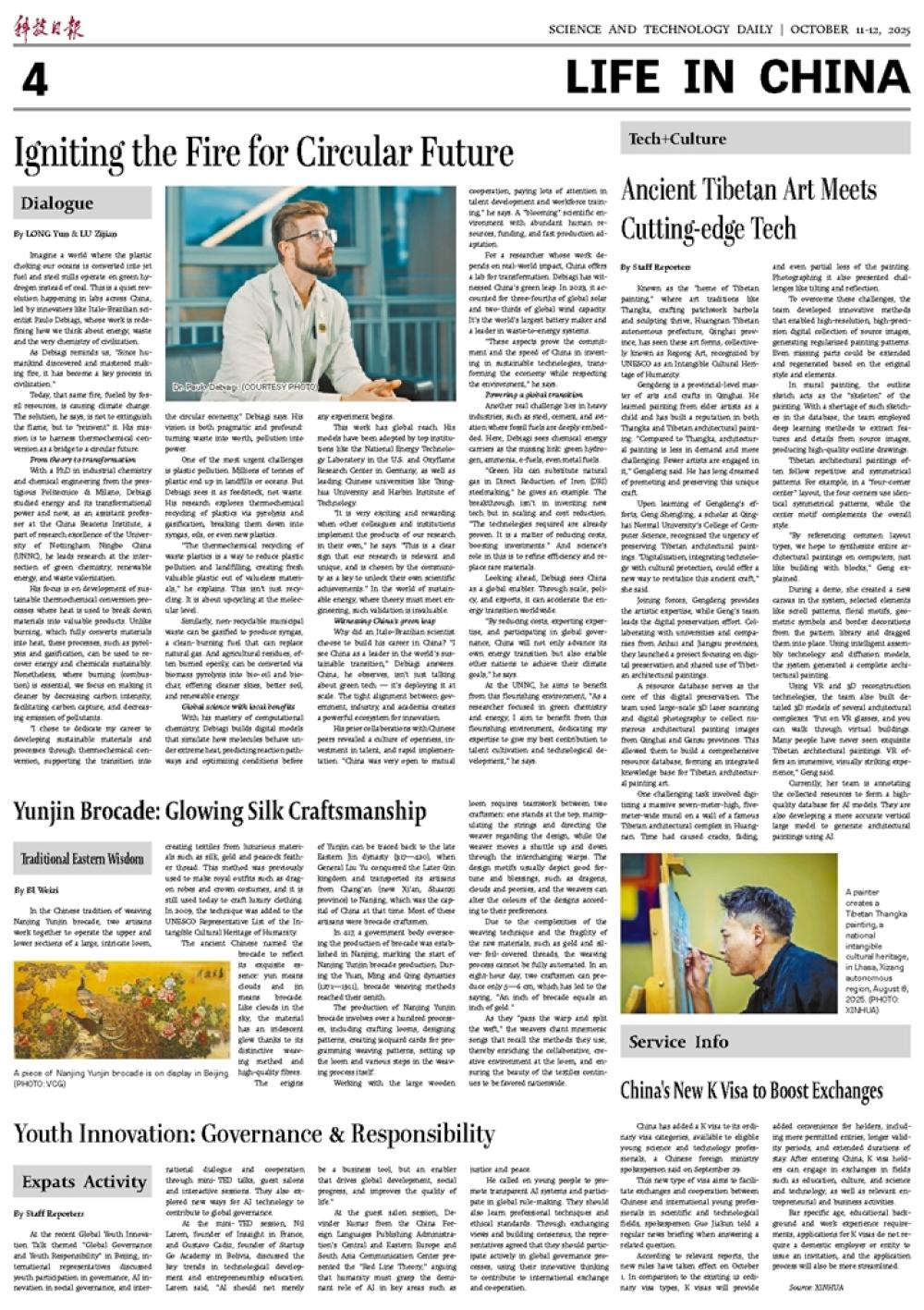
| Dr. Paulo Debiagi. (COURTESY PHOTO) |
Imagine a world where the plastic choking our oceans is converted into jet fuel and steel mills operate on green hydrogen instead of coal. This is a quiet revolution happening in labs across China, led by innovators like Italo-Brazilian scientist Paulo Debiagi, whose work is redefining how we think about energy, waste and the very chemistry of civilization.
As Debiagi reminds us, "Since humankind discovered and mastered making fire, it has become a key process in civilization."
Today, that same fire, fueled by fossil resources, is causing climate change. The solution, he says, is not to extinguish the flame, but to "reinvent" it. His mission is to harness thermochemical conversion as a bridge to a circular future.
From theory to transformation
With a PhD in industrial chemistry and chemical engineering from the prestigious Politecnico di Milano, Debiagi studied energy and its transformational power and now, as an assistant professor at the China Beacons Institute, a part of research excellence of the University of Nottingham Ningbo China (UNNC), he leads research at the intersection of green chemistry, renewable energy, and waste valorization.
His focus is on development of sustainable thermochemical conversion processes where heat is used to break down materials into valuable products. Unlike burning, which fully converts materials into heat, these processes, such as pyrolysis and gasification, can be used to recover energy and chemicals sustainably. Nonetheless, where burning (combustion) is essential, we focus on making it cleaner by decreasing carbon intensity, facilitating carbon capture, and decreasing emission of pollutants.
"I chose to dedicate my career to developing sustainable materials and processes through thermochemical conversion, supporting the transition into the circular economy," Debiagi says. His vision is both pragmatic and profound: turning waste into worth, pollution into power.
One of the most urgent challenges is plastic pollution. Millions of tonnes of plastic end up in landfills or oceans. But Debiagi sees it as feedstock, not waste. His research explores thermochemical recycling of plastics via pyrolysis and gasification, breaking them down into syngas, oils, or even new plastics.
"The thermochemical recycling of waste plastics is a way to reduce plastic pollution and landfilling, creating fresh valuable plastic out of valueless materials," he explains. This isn't just recycling. It is about upcycling at the molecular level.
Similarly, non-recyclable municipal waste can be gasified to produce syngas, a clean-burning fuel that can replace natural gas. And agricultural residues, often burned openly, can be converted via biomass pyrolysis into bio-oil and biochar, offering cleaner skies, better soil, and renewable energy.
Global science with local benefits
With his mastery of computational chemistry, Debiagi builds digital models that simulate how molecules behave under extreme heat, predicting reaction pathways and optimizing conditions before any experiment begins.
This work has global reach. His models have been adopted by top institutions like the National Energy Technology Laboratory in the U.S. and Oxyflame Research Center in Germany, as well as leading Chinese universities like Tsinghua University and Harbin Institute of Technology.
"It is very exciting and rewarding when other colleagues and institutions implement the products of our research in their own," he says. "This is a clear sign that our research is relevant and unique, and is chosen by the community as a key to unlock their own scientific achievements." In the world of sustainable energy, where theory must meet engineering, such validation is invaluable.
Witnessing China's green leap
Why did an Italo-Brazilian scientist choose to build his career in China? "I see China as a leader in the world's sustainable transition," Debiagi answers. China, he observes, isn't just talking about green tech — it's deploying it at scale. The tight alignment between government, industry, and academia creates a powerful ecosystem for innovation.
His prior collaborations with Chinese peers revealed a culture of openness, investment in talent, and rapid implementation. "China was very open to mutual cooperation, paying lots of attention in talent development and workforce training," he says. A "blooming" scientific environment with abundant human resources, funding, and fast production adaptation.
For a researcher whose work depends on real-world impact, China offers a lab for transformation. Debiagi has witnessed China's green leap. In 2023, it accounted for three-fourths of global solar and two-thirds of global wind capacity. It's the world's largest battery maker and a leader in waste-to-energy systems.
"These aspects prove the commitment and the speed of China in investing in sustainable technologies, transforming the economy while respecting the environment," he says.
Powering a global transition
Another real challenge lies in heavy industries, such as steel, cement, and aviation where fossil fuels are deeply embedded. Here, Debiagi sees chemical energy carriers as the missing link: green hydrogen, ammonia, e-fuels, even metal fuels.
"Green H2 can substitute natural gas in Direct Reduction of Iron (DRI) steelmaking," he gives an example. The breakthrough isn't in inventing new tech but in scaling and cost reduction. "The technologies required are already proven. It is a matter of reducing costs, boosting investments." And science's role in this is to refine efficiency and replace rare materials.
Looking ahead, Debiagi sees China as a global enabler. Through scale, policy, and exports, it can accelerate the energy transition worldwide.
"By reducing costs, exporting expertise, and participating in global governance, China will not only advance its own energy transition but also enable other nations to achieve their climate goals," he says.
At the UNNC, he aims to benefit from this flourishing environment, "As a researcher focused in green chemistry and energy, I aim to benefit from this flourishing environment, dedicating my expertise to give my best contribution to talent cultivation and technological development," he says.