


 |
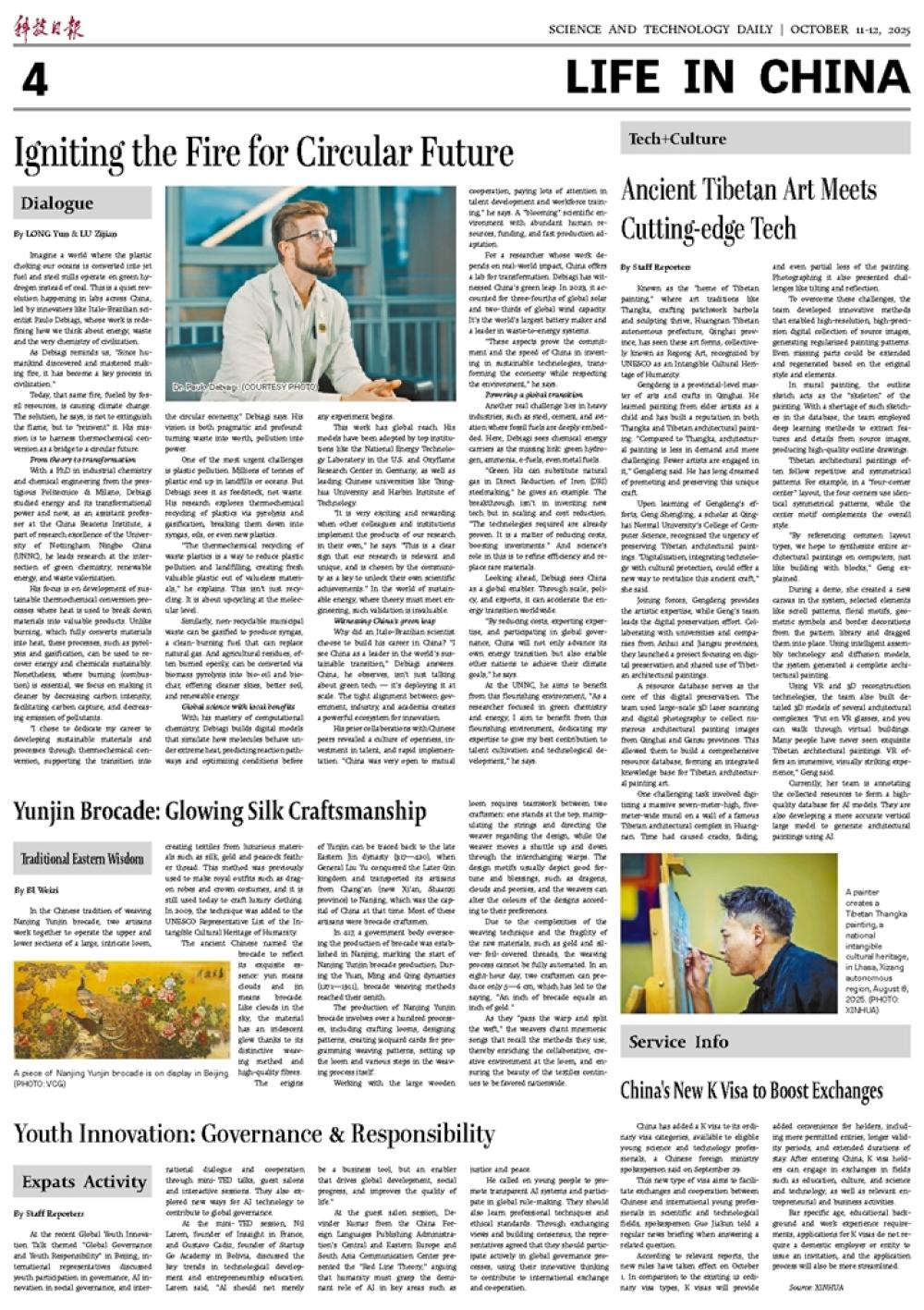
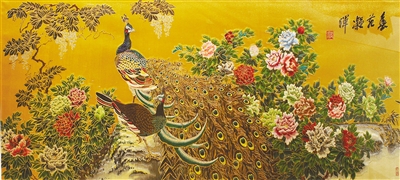
| A piece of Nanjing Yunjin brocade is on display in Beijing. (PHOTO: VCG) |
In the Chinese tradition of weaving Nanjing Yunjin brocade, two artisans work together to operate the upper and lower sections of a large, intricate loom, creating textiles from luxurious materials such as silk, gold and peacock feather thread. This method was previously used to make royal outfits such as dragon robes and crown costumes, and it is still used today to craft luxury clothing. In 2009, the technique was added to the UNESCO Representative List of the Intangible Cultural Heritage of Humanity.
The ancient Chinese named the brocade to reflect its exquisite essence: yun means clouds and jin means brocade. Like clouds in the sky, the material has an iridescent glow thanks to its distinctive weaving method and high-quality fibres.
The origins of Yunjin can be traced back to the late Eastern Jin dynasty (317—420), when General Liu Yu conquered the Later Qin kingdom and transported its artisans from Chang'an (now Xi'an, Shaanxi province) to Nanjing, which was the capital of China at that time. Most of these artisans were brocade craftsmen.
In 417, a government body overseeing the production of brocade was established in Nanjing, marking the start of Nanjing Yunjin brocade production. During the Yuan, Ming and Qing dynasties (1271—1911), brocade weaving methods reached their zenith.
The production of Nanjing Yunjin brocade involves over a hundred processes, including crafting looms, designing patterns, creating jacquard cards for programming weaving patterns, setting up the loom and various steps in the weaving process itself.
Working with the large wooden loom requires teamwork between two craftsmen: one stands at the top, manipulating the strings and directing the weaver regarding the design, while the weaver moves a shuttle up and down through the interchanging warps. The design motifs usually depict good fortune and blessings, such as dragons, clouds and peonies, and the weavers can alter the colours of the designs according to their preferences.
Due to the complexities of the weaving technique and the fragility of the raw materials, such as gold and silver-foil-covered threads, the weaving process cannot be fully automated. In an eight-hour day, two craftsmen can produce only 5—6 cm, which has led to the saying, "An inch of brocade equals an inch of gold."
As they "pass the warp and split the weft," the weavers chant mnemonic songs that recall the methods they use, thereby enriching the collaborative, creative environment at the loom, and ensuring the beauty of the textiles continues to be favored nationwide.