

 Next
Next


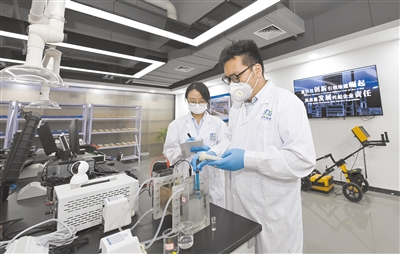 |
| A series of policies have been rolled out recently to provide more opportunities to young researchers and reduce their burdens. Photo shows young researchers are doing experiment on electrokinetic remediation of soil in Xixian New Area, Shaanxi province. (PHOTO: XINHUA) |
More opportunities and less burden are in the cards for young researchers, according to a notification jointly released by five government bodies including the Ministry of Science and Technology this month.
The notification is one of the latest moves to support young researchers and motivate their innovation abilities.
Wu Enxiu is one of beneficiaries of such moves. When he earned his PhD last July, the deadline to apply for the Young Scientist Fund under the National Natural Science Foundation of China had already passed.
Without fund support, his research couldn't go on. Fortunately, he landed projects from an innovation fund at his university and an open fund at his lab.
Thanks to the support, he has become an associate research fellow at Tianjin University.
With the new measures rolled out in the notification, more and more young researchers are expected to achieve their R&D goals.
The notification puts forward a series of special campaigns and support measures, such as uplifting the proportion of young talent in research projects, particularly in key projects and national projects, increasing R&D opportunities for them, reducing relevant evaluation and assessment requirements, and ensuring they have enough R&D time.
The proportion of young researchers who undertake leading or key roles in national R&D programs will be elevated to 20 percent, according to the notification.
Focusing on young talent in the field of basic sciences, special pilot programs will also be carried out.
Universities, research institutes and relative units are urged to evaluate young researchers based on their contributions, instead of only valuing the number of papers they publish.
In recent years, young researchers have played an increasingly important role in sci-tech innovation. Official statistics show that those aged 39 or under account for 78 percent of human resources in science and technology.