

 Next
Next


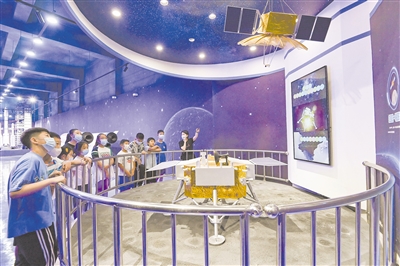 |
| Children learn the knowledge of aerospace science and technology at an artificial intelligence experience center in Weifang, Shandong province. (PHOTO: VCG) |
For many individuals, scientific literacy reflects their understanding of scientific concepts, phenomena and processes, which is also the foundation for a country to advance further and grow stronger.
Sci-tech innovation and science popularization are the two wings of innovative development. The coordinated development between science popularization and sci-tech innovation is good for the improvement of the scientific literacy of citizens.
To make science more popular in the new era, the National Plan for the Popularization and Development of Science and Technology During the 14th Five-Year Plan Period was released by the Ministry of Science and Technology and two other departments on August 16.
By 2020, the proportion of citizens with scientific literacy in China had reached 10.56 percent, thanks to a series of science outreach programs achieving the goal of over 10 percent set during the 13th Five-Year Plan period.
According to the plan, more than 15 percent of citizens will be science literate by 2025. Meanwhile, besides the funding support from government, a more diversified investment mechanism is expected to be established, which encourages enterprises, social organizations and individuals to contribute their share.
There were 1,525 sci-tech museums nationwide in 2020, an increase of 21.2 percent over 2015. In this plan, the establishment of science popularization bases with regional, industrial, and disciplinary characteristics is supported, and a number of national educational bases will be created to enlarge the infrastructure coverage.
The plan said that research institutes should motivate the enthusiasm of researchers and scientists to participate in science popularization through policy guidance, financial support and assessment. It also calls for promoting the spirit of scientists, and cultivating a fashion of advocating science and encouraging innovation across society.
Moreover, the research institutes are expected to promote the popularization of sci-tech innovation resources, focus on frontier research fields to carry out targeted science popularization, and give full play to the role of science popularization in advancing the commercialization of sci-tech achievements.
Notably, rural areas feature prominently in this plan. Specialists and experts in culture and science will be dispatched regularly to the rural areas to share their experience with farmers and help them to live and do business in a scientific way.
With regards to such common challenges faced by humankind as food security, energy security, human health, disaster risks, climate change and environmental protection, China will plan and organize international activities to enhance global consensus on country-level cooperation.
In addition, non-governmental exchanges are to be expanded. The universities, social organizations and enterprises are encouraged to participate in this move. Science popularization products catering to global tastes will be developed and promoted worldwide, and the introduction of renowned international science popularization works is also welcomed, said the plan.