

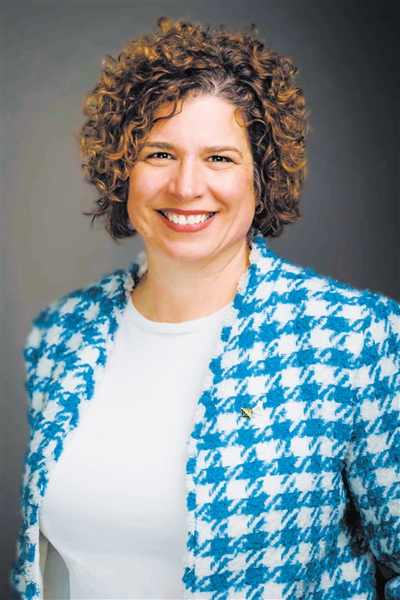
 |
| ▲ Sarah Tegen, chief publishing officer of ACS |
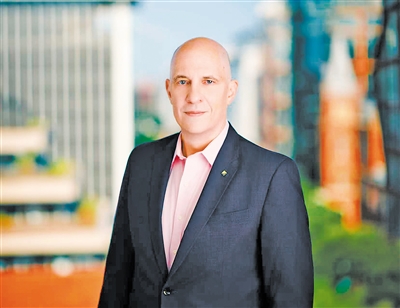 |
| ▲ Albert Horvath, CEO of ACS |
According to the American Chemical Society (ACS), more than 40 percent of the papers its journals publish now come from institutions in China, while the number of publications authored by researchers in China has quadrupled over the past decade. ACS has also expanded its presence in China. It opened a Beijing office and hired its first employee there in 2013. The team now numbers about 50, and its partner publishing program in China has grown from one journal to nine.
Founded in New York in 1876 by 35 chemists, ACS is one of the world's largest scientific societies and publishes more than 90 peer-reviewed journals. Albert Horvath, its chief executive officer, and Sarah Tegen, its chief publishing officer, spoke to Science and Technology Daily about China's growing weight in ACS publishing and what it means for future cooperation.
A global sci-tech leader
In 2024, Horvath visited China to attend the Chinese Chemical Society congress in southern Guangdong province. Before the meeting, he visited the Shenzhen Institutes of Advanced Technology in the same province. "China's ability to take a concept, a vision, an idea, and then turn that into something tangible in a very, very short period of time was impressive," he said.
China's investment in scientific infrastructure and its support for researchers have contributed to the progress across Chinese institutions, he said. What struck him was how quickly research turns into practical applications, new industries, new opportunities and solutions to real problems. Over the years, he has watched China's scientific progress "with amazement."
In October, Horvath and his team visited the National Natural Science Foundation of China in Beijing, which supports basic research. According to him, applied strength matters but basic research cannot be neglected. "Really interesting new ideas" emerge from curiosity-driven research, and great discoveries often come from "an individual scientist just following their intuition and their passion."
Tegen first came to China in 2008 and has watched the shift from within the publishing industry. "Energy, catalysis, materials science and AI-enabled discovery are among the many fields where China is particularly strong," she said, noting the Chinese government's ability to set a research direction and mobilize scientists quickly. "China has evolved from an important contributor to science into a real global leader. The kinds of scientific innovations coming out of China are well poised to help all of humanity solve difficult problems."
Quality at the core in the AI era
Today AI is reshaping how research is produced and published, putting research integrity under new pressure. For a major international society like ACS, the impact of AI on research and publishing cannot be ignored.
ACS makes research integrity a daily operational priority. Threats to research integrity existed before AI exploded onto the scene, Horvath said, but AI "changes the dynamic and accelerates the concern." The main change is volume. "You're getting volumes of information that are just incomprehensible to a human reader." As a scientific society, ACS has a role "in promulgating principles of responsible use."
AI can help authors work more efficiently, Tegen said, but it can also be misused to fabricate data and produce unreliable scientific content. ACS spends "significant time and resources" screening for such work. It was one of the first publishers to require authors to disclose their use of AI in creating research or research outputs, and its policy goes beyond disclosure.
Cooperation is essential
China has become one of the most important sources of content for ACS journals. Tegen called the rise of the Chinese journal ecosystem "really positive for global research," because researchers have more choices than ever. ACS has to "continue to earn their trust" through rigorous peer review, research integrity and international visibility, she said.
That trust is built through cooperation. "We look for areas of overlap, where our missions align," Horvath said. In its 150-year history, ACS has endured many changes in its environment while staying focused on supporting scientists and the scientific enterprise.
Over the next five years, he wants to "extend, expand and deepen" the work already underway, and to be measured by outcomes rather than conferences and reports: a stronger talent pipeline, sufficient resources and greater trust between partners.
ACS states its commitment as "to improve all lives through the transforming power of chemistry."
"Individual researchers working alone in single labs really don't drive progress these days. It's really the ability to network people across disciplines and across geographies that really leads to the big breakthroughs," Horvath said. International cooperation is "a critical ingredient in our success as human beings in the future."
Tegen, who has spent her whole career in publishing, defines a journal's objective as existing to help shape a community of scientists and set norms and standards, and that community "can't exist in one geography." "Science anywhere is good for science everywhere," she said, quoting a line she had heard recently.