

 Next


 |
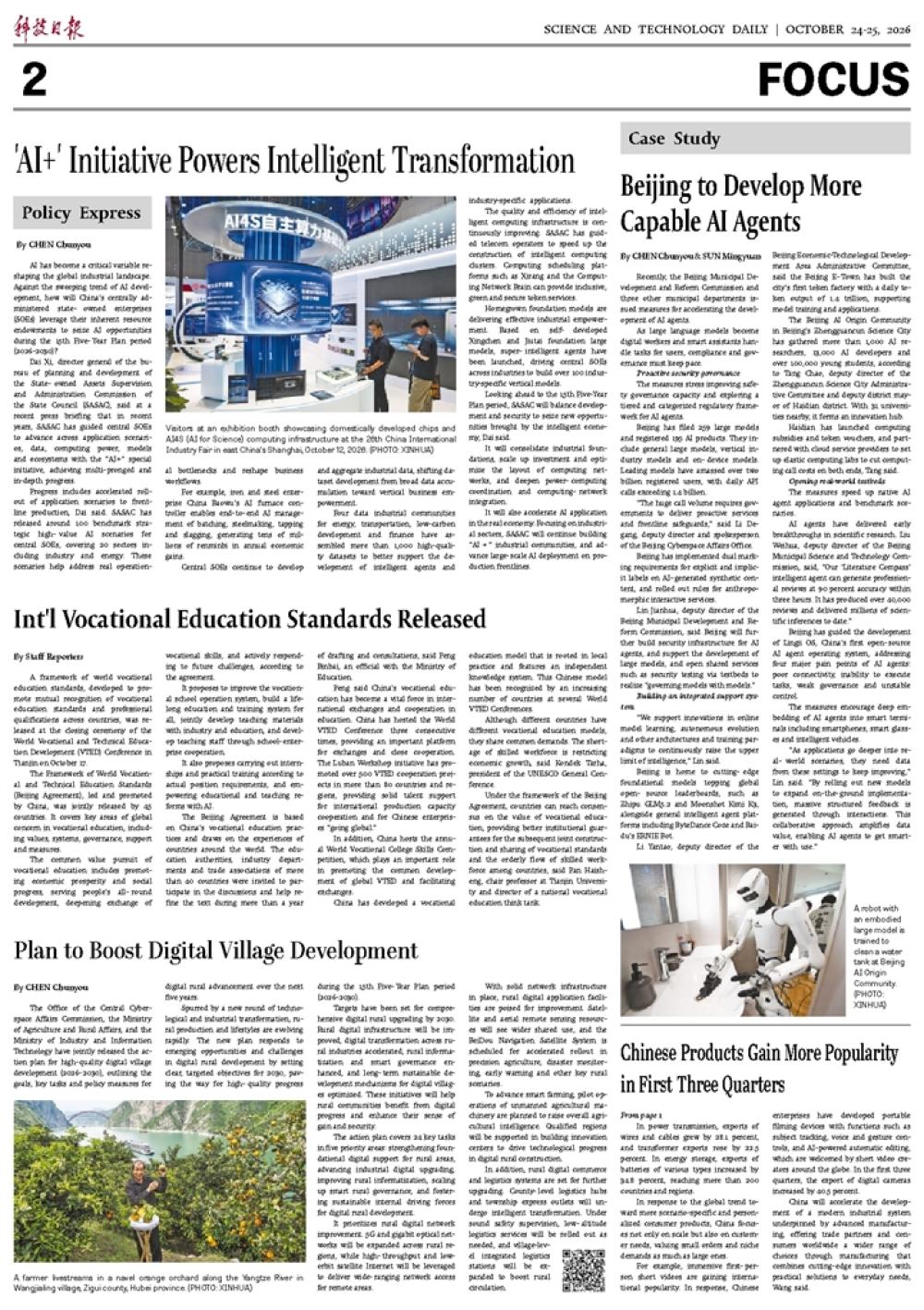
| A farmer livestreams in a navel orange orchard along the Yangtze River in Wangjialing village, Zigui county, Hubei province. (PHOTO: XINHUA) |
 |
The Office of the Central Cyberspace Affairs Commission, the Ministry of Agriculture and Rural Affairs, and the Ministry of Industry and Information Technology have jointly released the action plan for high-quality digital village development (2026-2030), outlining the goals, key tasks and policy measures for digital rural advancement over the next five years.
Spurred by a new round of technological and industrial transformation, rural production and lifestyles are evolving rapidly. The new plan responds to emerging opportunities and challenges in digital rural development by setting clear, targeted objectives for 2030, paving the way for high-quality progress during the 15th Five-Year Plan period(2026-2030).
Targets have been set for comprehensive digital rural upgrading by 2030. Rural digital infrastructure will be improved, digital transformation across rural industries accelerated, rural informatization and smart governance enhanced, and long-term sustainable development mechanisms for digital villages optimized. These initiatives will help rural communities benefit from digital progress and enhance their sense of gain and security.
The action plan covers 24 key tasks in five priority areas: strengthening foundational digital support for rural areas, advancing industrial digital upgrading, improving rural informatization, scaling up smart rural governance, and fostering sustainable internal driving forces for digital rural development.
It prioritizes rural digital network improvement. 5G and gigabit optical networks will be expanded across rural regions, while high-throughput and low-orbit satellite Internet will be leveraged to deliver wide-ranging network access for remote areas.
With solid network infrastructure in place, rural digital application facilities are poised for improvement. Satellite and aerial remote sensing resources will see wider shared use, and the BeiDou Navigation Satellite System is scheduled for accelerated rollout in precision agriculture, disaster monitoring, early warning and other key rural scenarios.
To advance smart farming, pilot operations of unmanned agricultural machinery are planned to raise overall agricultural intelligence. Qualified regions will be supported in building innovation centers to drive technological progress in digital rural construction.
In addition, rural digital commerce and logistics systems are set for further upgrading. County-level logistics hubs and township express outlets will undergo intelligent transformation. Under sound safety supervision, low-altitude logistics services will be rolled out as needed, and village-level integrated logistics stations will be expanded to boost rural circulation.