

 Next


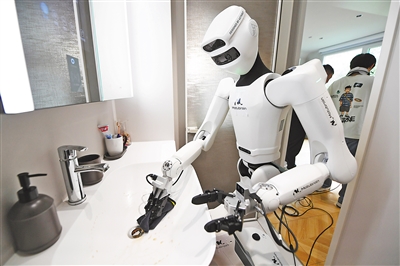 |
| A robot with an embodied large model is trained to clean a water tank at Beijing AI Origin Community. (PHOTO: XINHUA) |
Recently, the Beijing Municipal Development and Reform Commission and three other municipal departments issued measures for accelerating the development of AI agents.
As large language models become digital workers and smart assistants handle tasks for users, compliance and governance must keep pace.
Proactive security governance
The measures stress improving safety governance capacity and exploring a tiered and categorized regulatory framework for AI agents.
Beijing has filed 259 large models and registered 195 AI products. They include general large models, vertical industry models and on-device models. Leading models have amassed over two billion registered users, with daily API calls exceeding 1.4 billion.
"The huge call volume requires governments to deliver proactive services and frontline safeguards," said Li Degang, deputy director and spokesperson of the Beijing Cyberspace Affairs Office.
Beijing has implemented dual marking requirements for explicit and implicit labels on AI-generated synthetic content, and rolled out rules for anthropomorphic interactive services.
Lin Jianhua, deputy director of the Beijing Municipal Development and Reform Commission, said Beijing will further build security infrastructure for AI agents, and support the development of large models, and open shared services such as security testing via testbeds to realize "governing models with models."
Building an integrated support system
"We support innovations in online model learning, autonomous evolution and other architectures and training paradigms to continuously raise the upper limit of intelligence," Lin said.
Beijing is home to cutting-edge foundational models topping global open-source leaderboards, such as Zhipu GLM5.2 and Moonshot Kimi K3, alongside general intelligent agent platforms including ByteDance Coze and Baidu's ERNIE Bot.
Li Yantao, deputy director of the Beijing Economic-Technological Development Area Administrative Committee, said the Beijing E-Town has built the city's first token factory with a daily token output of 1.4 trillion, supporting model training and applications.
The Beijing AI Origin Community in Beijing's Zhongguancun Science City has gathered more than 1,000 AI researchers, 13,000 AI developers and over 100,000 young students, according to Tang Chao, deputy director of the Zhongguancun Science City Administrative Committee and deputy district mayor of Haidian district. With 31 universities nearby, it forms an innovation hub.
Haidian has launched computing subsidies and token vouchers, and partnered with cloud service providers to set up elastic computing labs to cut computing call costs on both ends, Tang said.
Opening real-world testbeds
The measures speed up native AI agent applications and benchmark scenarios.
AI agents have delivered early breakthroughs in scientific research. Liu Weihua, deputy director of the Beijing Municipal Science and Technology Commission, said, "Our 'Literature Compass' intelligent agent can generate professional reviews at 90 percent accuracy within three hours. It has produced over 40,000 reviews and delivered millions of scientific inferences to date."
Beijing has guided the development of Lingji OS, China's first open-source AI agent operating system, addressing four major pain points of AI agents: poor connectivity, inability to execute tasks, weak governance and unstable control.
The measures encourage deep embedding of AI agents into smart terminals including smartphones, smart glasses and intelligent vehicles.
"As applications go deeper into real-world scenarios, they need data from these settings to keep improving," Lin said. "By rolling out new models to expand on-the-ground implementation, massive structured feedback is generated through interactions. This collaborative approach amplifies data value, enabling AI agents to get smarter with use."