


 |
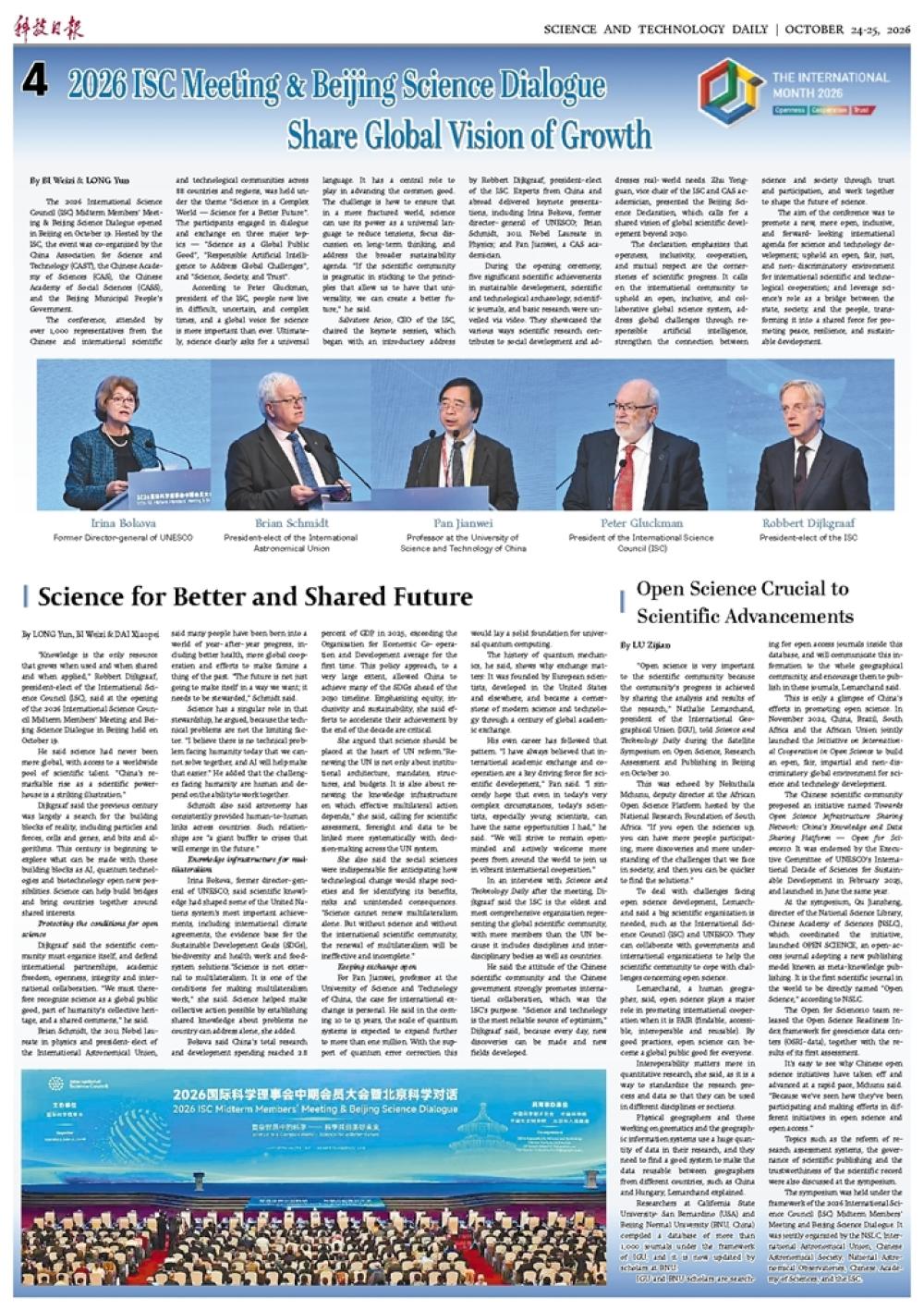
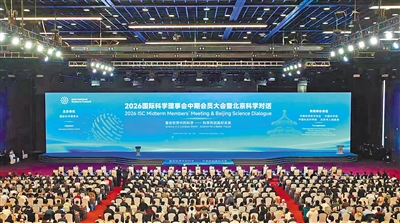
"Knowledge is the only resource that grows when used and when shared and when applied," Robbert Dijkgraaf, president-elect of the International Science Council (ISC), said at the opening of the 2026 International Science Council Midterm Members' Meeting and Beijing Science Dialogue in Beijing held on October 19.
He said science had never been more global, with access to a worldwide pool of scientific talent. "China's remarkable rise as a scientific powerhouse is a striking illustration."
Dijkgraaf said the previous century was largely a search for the building blocks of reality, including particles and forces, cells and genes, and bits and algorithms. This century is beginning to explore what can be made with those building blocks as AI, quantum technologies and biotechnology open new possibilities. Science can help build bridges and bring countries together around shared interests.
Protecting the conditions for open science
Dijkgraaf said the scientific community must organize itself, and defend international partnerships, academic freedom, openness, integrity and international collaboration. "We must therefore recognize science as a global public good, part of humanity's collective heritage, and a shared commons," he said.
Brian Schmidt, the 2011 Nobel laureate in physics and president-elect of the International Astronomical Union, said many people have been born into a world of year-after-year progress, including better health, more global cooperation and efforts to make famine a thing of the past. "The future is not just going to make itself in a way we want; it needs to be stewarded," Schmidt said.
Science has a singular role in that stewardship, he argued, because the technical problems are not the limiting factor. "I believe there is no technical problem facing humanity today that we cannot solve together, and AI will help make that easier." He added that the challenges facing humanity are human and depend on the ability to work together.
Schmidt also said astronomy has consistently provided human-to-human links across countries. Such relationships are "a giant buffer to crises that will emerge in the future."
Knowledge infrastructure for multilateralism
Irina Bokova, former director-general of UNESCO, said scientific knowledge had shaped some of the United Nations system's most important achievements, including international climate agreements, the evidence base for the Sustainable Development Goals (SDGs), biodiversity and health work and food-system solutions."Science is not external to multilateralism. It is one of the conditions for making multilateralism work," she said. Science helped make collective action possible by establishing shared knowledge about problems no country can address alone, she added.
Bokova said China's total research and development spending reached 2.8 percent of GDP in 2025, exceeding the Organisation for Economic Co-operation and Development average for the first time. This policy approach, to a very large extent, allowed China to achieve many of the SDGs ahead of the 2030 timeline. Emphasizing equity, inclusivity and sustainability, she said efforts to accelerate their achievement by the end of the decade are critical.
She argued that science should be placed at the heart of UN reform."Renewing the UN is not only about institutional architecture, mandates, structures, and budgets. It is also about renewing the knowledge infrastructure on which effective multilateral action depends," she said, calling for scientific assessment, foresight and data to be linked more systematically with decision-making across the UN system.
She also said the social sciences were indispensable for anticipating how technological change would shape societies and for identifying its benefits, risks and unintended consequences. "Science cannot renew multilateralism alone. But without science and without the international scientific community, the renewal of multilateralism will be ineffective and incomplete."
Keeping exchange open
For Pan Jianwei, professor at the University of Science and Technology of China, the case for international exchange is personal. He said in the coming 10 to 15 years, the scale of quantum systems is expected to expand further to more than one million. With the support of quantum error correction this would lay a solid foundation for universal quantum computing.
The history of quantum mechanics, he said, shows why exchange matters: It was founded by European scientists, developed in the United States and elsewhere, and became a cornerstone of modern science and technology through a century of global academic exchange.
His own career has followed that pattern. "I have always believed that international academic exchange and cooperation are a key driving force for scientific development," Pan said. "I sincerely hope that even in today's very complex circumstances, today's scientists, especially young scientists, can have the same opportunities I had," he said. "We will strive to remain open-minded and actively welcome more peers from around the world to join us in vibrant international cooperation."
In an interview with Science and Technology Daily after the meeting, Dijkgraaf said the ISC is the oldest and most comprehensive organization representing the global scientific community, with more members than the UN because it includes disciplines and interdisciplinary bodies as well as countries.
He said the attitude of the Chinese scientific community and the Chinese government strongly promotes international collaboration, which was the ISC's purpose. "Science and technology is the most reliable source of optimism," Dijkgraaf said, because every day, new discoveries can be made and new fields developed.