
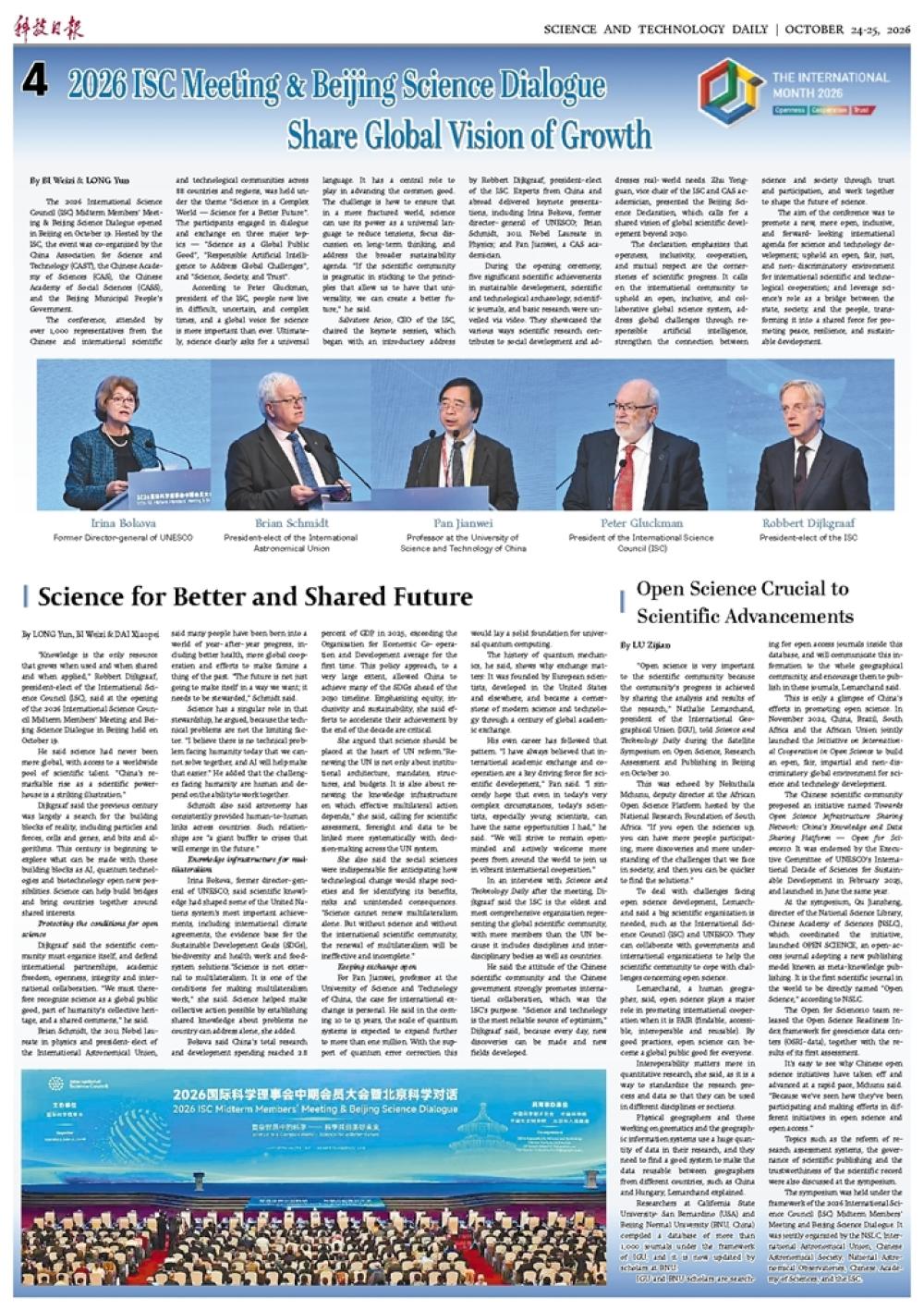


The 2026 International Science Council (ISC) Midterm Members' Meeting & Beijing Science Dialogue opened in Beijing on October 19. Hosted by the ISC, the event was co-organized by the China Association for Science and Technology (CAST), the Chinese Academy of Sciences (CAS), the Chinese Academy of Social Sciences (CASS), and the Beijing Municipal People's Government.
The conference, attended by over 1,000 representatives from the Chinese and international scientific and technological communities across 88 countries and regions, was held under the theme "Science in a Complex World — Science for a Better Future". The participants engaged in dialogue and exchange on three major topics — "Science as a Global Public Good", "Responsible Artificial Intelligence to Address Global Challenges", and "Science, Society, and Trust".
According to Peter Gluckman, president of the ISC, people now live in difficult, uncertain, and complex times, and a global voice for science is more important than ever. Ultimately, science clearly asks for a universal language. It has a central role to play in advancing the common good. The challenge is how to ensure that in a more fractured world, science can use its power as a universal language to reduce tensions, focus discussion on long-term thinking, and address the broader sustainability agenda. "If the scientific community is pragmatic in sticking to the principles that allow us to have that universality, we can create a better future," he said.
Salvatore Arico, CEO of the ISC, chaired the keynote session, which began with an introductory address by Robbert Dijkgraaf, president-elect of the ISC. Experts from China and abroad delivered keynote presentations, including Irina Bokova, former director-general of UNESCO; Brian Schmidt, 2011 Nobel Laureate in Physics; and Pan Jianwei, a CAS academician.
During the opening ceremony, five significant scientific achievements in sustainable development, scientific and technological archaeology, scientific journals, and basic research were unveiled via video. They showcased the various ways scientific research contributes to social development and addresses real-world needs. Zhu Yongguan, vice chair of the ISC and CAS academician, presented the Beijing Science Declaration, which calls for a shared vision of global scientific development beyond 2030.
The declaration emphasizes that openness, inclusivity, cooperation, and mutual respect are the cornerstones of scientific progress. It calls on the international community to uphold an open, inclusive, and collaborative global science system, address global challenges through responsible artificial intelligence, strengthen the connection between science and society through trust and participation, and work together to shape the future of science.
The aim of the conference was to promote a new, more open, inclusive, and forward-looking international agenda for science and technology development; uphold an open, fair, just, and non-discriminatory environment for international scientific and technological cooperation; and leverage science's role as a bridge between the state, society, and the people, transforming it into a shared force for promoting peace, resilience, and sustainable development.