

 Next
Next


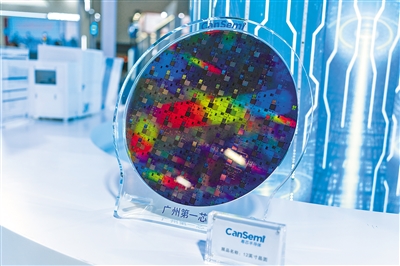 |
| A 12-inch silicon wafer is showcased at an exhibition presenting the latest achievements of China's integrated circuit manufacturing in Guangzhou, September 4. (PHOTO: VCG) |
 |
China has unveiled a comprehensive roadmap to upgrade its electronic information manufacturing sector, aiming for the operating revenue of enterprises above designated size to surpass 30 trillion RMB by 2030.
Jointly issued by the Ministry of Industry and Information Technology and the National Development and Reform Commission, the plan also targets the sector's research and development intensity to reach 3.5 percent.
Computing power supply capacity is set to grow substantially, while the uptake of new-generation intelligent terminals is expected to rise significantly.
By 2030, the plan envisions the emergence of a batch of technologies and products in integrated circuits (IC), advanced computing, consumer electronics, basic electronics and energy electronics. It also targets coordinated progress in hardware, software, standards and patents, improved regional layout and international cooperation, and higher levels of intelligent, green and integrated development.
Seventeen key tasks have been outlined across four dimensions: foundation building, quality upgrading, nurturing new growth drivers, and governance.
Chips, components and smart sensors
The plan urges full-chain breakthroughs in the IC sector, calling for the development of high-end chips including high-performance processors, high-density memory, and high-reliability analog and mixed-signal chips.
It also promotes high-end development of electronic components and materials, accelerating the development of mature, reliable and widely applicable "off-the-shelf" foundational industrial products — standardized products ready for direct use — to serve key sectors such as artificial intelligence, new-generation information and communications, aerospace, and new-generation intelligent terminals.
Manufacturing capabilities for intelligent sensors such as micro-electro-mechanical systems will be enhanced, with faster integration of smart sensors into key industries and application scenarios.
During the 2026-2030 period, China will pursue technological breakthroughs in the core segments of the photonics industry, build common-process platforms for micro-nano fabrication and optoelectronic integrated packaging, and strengthen R&D of photonic functional and process materials.
Intelligent terminals & advanced computing
The plan calls for sustained promotion and upgrading of AI smartphones, personal computers, smart glasses, audio-visual terminals, in-vehicle terminals, industrial terminals and commercial terminals, while accelerating deep integration of AI agents with such terminal products.
To build an advanced computing ecosystem, breakthroughs will be accelerated in computing architecture, data storage, high-speed interconnection, software-hardware synergy and computing-energy synergy.
The layout of new computing paradigms including quantum computing, optical computing, neuromorphic computing and space computing will be advanced.
New growth points
To cultivate new growth drivers, the spatiotemporal information industry will be fostered and the AI hardware foundation consolidated.
This involves integrating the BeiDou Navigation Satellite System, satellite Internet, and space remote sensing to connect the full industry chain from chips to services. Additionally, the development of cloud training equipment and inference devices/chips for embodied AI and autonomous driving will be accelerated.
The plan emphasizes deep integration of electronic technologies with real-world demands including smart cities, smart agriculture, intelligent driving, smart healthcare, the low-altitude economy, commercial spaceflight, and deep-sea and polar exploration.
In addition, China will build a new pattern of open international cooperation in electronic information, participate in international standardization activities, and promote more Chinese standards going global.