

 Next
Next


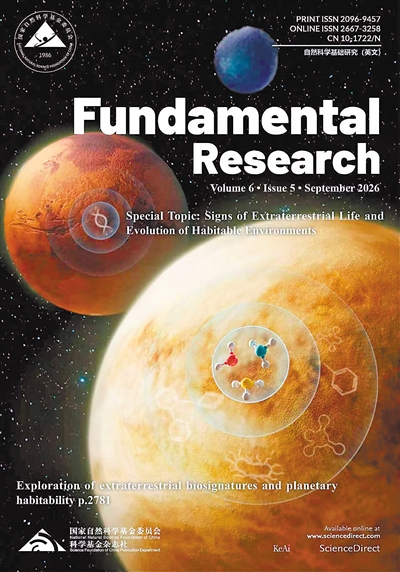 |
| Front cover of Fundamental Research, Volume 6, Issue 5. (COURTESY PHOTO) |
According to the 2025 Journal Citation Reports (JCR) released by Clarivate in June, Fundamental Research, sponsored by the National Natural Science Foundation of China (NSFC), boasts an impact factor of 7.0, ranking in the top 13.6 percent of global multidisciplinary journals and securing a place in the SCI Q1 category.
Launched in 2021, the journal is currently indexed by over 10 authoritative databases, including ESCI, Scopus, PubMed and CSCD, evolving into a mature international venue for interdisciplinary exchange.
Breaking down disciplinary barriers of single-field journals
Currently, most domestic journals are discipline-specific and struggle to accommodate interdisciplinary integration and collaborative efforts to tackle key research challenges.
NSFC funds many high-impact interdisciplinary basic research findings. Lacking suitable domestic publishing venues, China's vast original research results have long been published in overseas journals. As a result, the initial dissemination and academic influence of these achievements accumulate within international publishing systems, thereby constraining the academic discourse power of domestic publishing platforms.
Fundamental Research serves global researchers across nine fields: mathematics and physics, chemistry, life sciences, Earth sciences, engineering and materials, information science, management, medicine, and interdisciplinary sciences. It fosters cross-field exchange, generates original interdisciplinary results, and advances the "dual return" of funded research, bringing both high-quality publications and academic influence back to domestic platforms.
Weaving an interdisciplinary academic network
Future scientific breakthroughs will largely emerge at disciplinary intersections. Challenges including carbon neutrality, frontier information technology and life-health issues cannot be addressed by single-discipline research alone. Fundamental Research therefore prioritizes frontier interdisciplinary topics.
Instead of chasing hot topics or fixed themes, the journal plans around national strategic demands and global research gaps, and uses customized special topics to break down disciplinary barriers.
To date, it has launched over 40 frontier topics spanning quantum information, electronic materials, RNA diagnostics and therapeutics and smart transportation.
The Special Topic on Advanced Terahertz Sciences and Technologies published in 2025 exemplifies this approach. Terahertz research encompasses physics, electronic information, biomedicine and materials engineering, yet it has long been plagued by fragmentation and application gaps that single-discipline journals are unable to bridge.
The journal pioneered this special topic, inviting academics from leading institutions, such as the Nanyang Technological University and the University of Shanghai for Science and Technology, and assembling landmark global findings. With coverage ranging from detection and communication security to intelligent devices and biosensing, it has built a comprehensive chain from basic mechanisms and device innovation to industrial application. Seven of its articles have received over 200 citations.
A diverse editorial board and a credible peer review system
The journal emphasizes the quality and balance of its academic lineup, assembling a global editorial and youth editorial board of over 540 leading scholars. Its review process is guided solely by scientific innovation, setting aside nationality, affiliation, title and seniority.
With over 7,000 experts worldwide evaluating submissions under unified, rigorous international standards, it has established a fair, globally trusted platform that fosters research collaboration.
Cultivating a borderless research community
The ultimate value of a top-tier journal does not lie in article volume, but in its ability to foster a sustainable global academic ecosystem.
Fundamental Research hosts interdisciplinary forums for researchers worldwide and adopts a diamond open-access model with no article-processing charges, serving as a key window for China's basic research and an inclusive global academic platform.
In the 15th Five-Year Plan's opening year, we will deepen collaboration in quantum technology, green transition, and biological interdisciplinary research to address humanity's shared scientific challenges.
The author is editor-in-chief of Fundamental Research, an academician of the Chinese Academy of Sciences, and a Boya Distinguished Professor at Peking University.
Journal Review
For a long time, China's high-quality research results flowed overseas, while high-end domestic multidisciplinary international journals were scarce, constraining the country's independence in fundamental research innovation and the enhancement of its academic discourse power.
As a multidisciplinary journal, Fundamental Research promotes innovation by planning frontier topics, ensures academic integrity by employing international editorial boards, and enables global academic sharing by adopting a public-interest diamond open access model, which addresses the shortcomings in the development of the industry precisely.
Looking ahead, the journal should keep abreast of advances at the frontier of disciplinary development, pursue progressive innovation, and further explore strategic frontier areas. It should advance global research and innovation cooperation, and facilitate independent dissemination of China's basic research outcomes.
—— Yang Wei, academician of the Chinese Academy of Sciences and professor at Zhejiang University