


 |
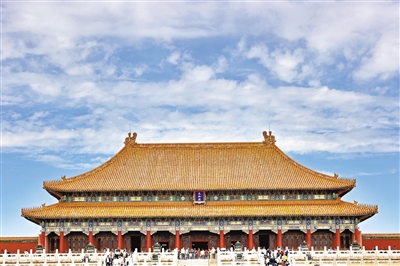
| A picture of Hall of Supreme Harmony (Taihe Dian) in the Forbidden City in Beijing. (PHOTO: VCG) |
There is a folk saying, "Beijing's city, Linqing's bricks," highlighting the special status of Linqing tribute bricks in building Beijing's iconic architecture. These grey bricks, made in kilns in the city of Linqing in Shandong province, east China, were used in the imperial architecture of the Ming (1368-1644) and Qing (1644-1911) dynasties. Grand structures such as the "Forbidden City" —known as the Palace Museum today — and the Temple of Heaven in Beijing were built with these bricks, renowned for producing a resonant sound when struck, and displaying a dense, pore-free cross-section when broken.
However, with the decline of the canal transport system, production of the bricks ceased in the late Qing Dynasty, and this traditional craft was on the verge of being lost.
But since 2016, with the support of the National Natural Science Foundation of China, teams led by Professor Zhang Long and Professor Hou Feng from Tianjin University (TJU) in north China, have collaborated with intangible cultural heritage inheritor Zhao Qing'an, to revitalize this ancient craft through modern technology.
Their first step was to create a systematic scientific archive for the Linqing tribute bricks. Fieldwork, oral history interviews and archival research clarified the production management systems and distribution channels for the imperial bricks. Then they compiled the data from the inscriptions on the bricks and identified 440 kiln operators and 232 artisans and foremen, establishing a lineage of the craftspeople involved.
The team developed a technical framework combining in-situ testing with laboratory analysis to create a "genetic profile" — characterized by elemental composition and mineral phases — to trace the bricks' origins. "Grey bricks from different locations possess unique geochemical fingerprints," Zhang said. "Like DNA, these help us to scientifically determine their source."
The "soul" of the Linqing tribute bricks lies in the local high-quality "lotus soil." However, that has become increasingly scarce due to land conservation policies. Zhao sourced clay from river dredging operations, but the material's composition varied significantly, making it difficult to consistently replicate the quality of ancient bricks based on experience alone.
To address this, the team analyzed high-quality ancient bricks to reverse-engineer their firing temperatures and raw material compositions. Extensive experiments on mixing ratios and firing processes uncovered the links between soil composition, firing temperature and the resulting brick properties. Hou said, "We helped the inheritors transform their indescribable experience into quantifiable, replicable scientific parameters."
The team was able to develop various formulas that ensured that the bricks made from alternative soil sources matched the standards of the traditional imperial tribute bricks.
For the firing process, they collaborated with the School of Earth System Science of TJU to utilize isotope geochemical tracing methods. They established a database of material characteristics and a method for tracing the bricks' origin, establishing scientific criteria for identifying suitable brick materials for the restoration of ancient architecture.
Today, the modern "Linqing tribute bricks" have become the preferred choice for restoration projects at cultural heritage sites. The Tribute Brick Cultural Industry Park, established by Zhao in Linqing, has been designated as a base for grey brick materials used in historic architecture in Beijing. While ensuring a steady supply of materials for heritage restoration, the park has created jobs for over a hundred villagers, turning this intangible cultural heritage into a new engine for rural revitalization.
From experience-based inheritance to scientific understanding, and from verging on extinction to rekindled kiln fires — this cross-disciplinary collaboration between technology and craftsmanship has ensured that the six-century-old tradition grows stronger in the new era.