


 |
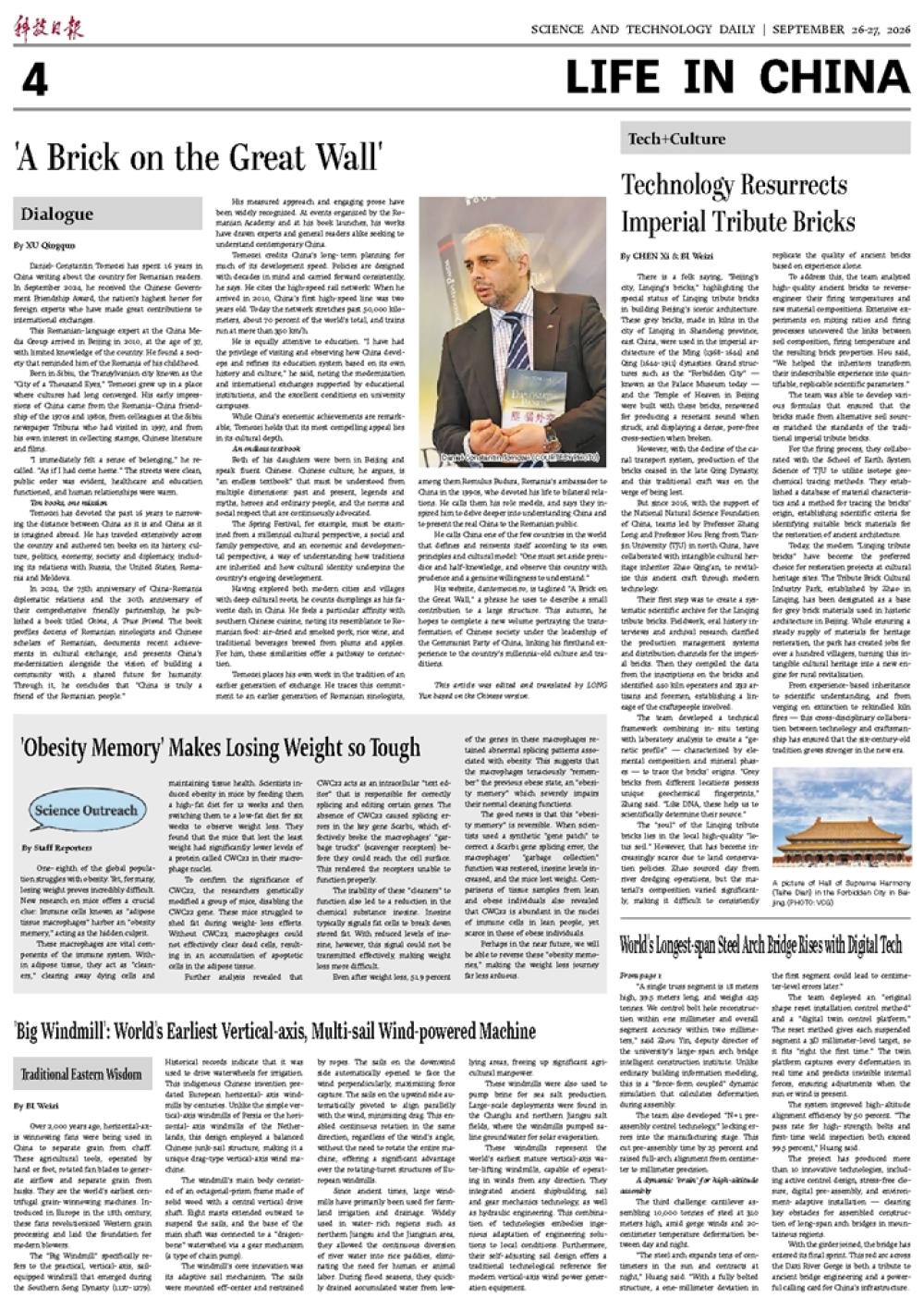
| Daniel-Constantin Tomozei. (COURTESY PHOTO) |
Daniel-Constantin Tomozei has spent 16 years in China writing about the country for Romanian readers. In September 2024, he received the Chinese Government Friendship Award, the nation's highest honor for foreign experts who have made great contributions to international exchanges.
This Romanian-language expert at the China Media Group arrived in Beijing in 2010, at the age of 37, with limited knowledge of the country. He found a society that reminded him of the Romania of his childhood.
Born in Sibiu, the Transylvanian city known as the "City of a Thousand Eyes," Tomozei grew up in a place where cultures had long converged. His early impressions of China came from the Romania-China friendship of the 1970s and 1980s, from colleagues at the Sibiu newspaper Tribuna who had visited in 1997, and from his own interest in collecting stamps, Chinese literature and films.
"I immediately felt a sense of belonging," he recalled. "As if I had come home." The streets were clean, public order was evident, healthcare and education functioned, and human relationships were warm.
Ten books, one mission
Tomozei has devoted the past 16 years to narrowing the distance between China as it is and China as it is imagined abroad. He has traveled extensively across the country and authored ten books on its history, culture, politics, economy, society and diplomacy, including its relations with Russia, the United States, Romania and Moldova.
In 2024, the 75th anniversary of China-Romania diplomatic relations and the 20th anniversary of their comprehensive friendly partnership, he published a book titled China, A True Friend. The book profiles dozens of Romanian sinologists and Chinese scholars of Romanian, documents recent achievements in cultural exchange, and presents China's modernization alongside the vision of building a community with a shared future for humanity. Through it, he concludes that "China is truly a friend of the Romanian people."
His measured approach and engaging prose have been widely recognized. At events organized by the Romanian Academy and at his book launches, his works have drawn experts and general readers alike seeking to understand contemporary China.
Tomozei credits China's long-term planning for much of its development speed. Policies are designed with decades in mind and carried forward consistently, he says. He cites the high-speed rail network: When he arrived in 2010, China's first high-speed line was two years old. Today the network stretches past 50,000 kilometers, about 70 percent of the world's total, and trains run at more than 350 km/h.
He is equally attentive to education. "I have had the privilege of visiting and observing how China develops and refines its education system based on its own history and culture," he said, noting the modernization and international exchanges supported by educational institutions, and the excellent conditions on university campuses.
While China's economic achievements are remarkable, Tomozei holds that its most compelling appeal lies in its cultural depth.
An endless textbook
Both of his daughters were born in Beijing and speak fluent Chinese. Chinese culture, he argues, is "an endless textbook" that must be understood from multiple dimensions: past and present, legends and myths, heroes and ordinary people, and the norms and social respect that are continuously advocated.
The Spring Festival, for example, must be examined from a millennial cultural perspective, a social and family perspective, and an economic and developmental perspective, a way of understanding how traditions are inherited and how cultural identity underpins the country's ongoing development.
Having explored both modern cities and villages with deep cultural roots, he counts dumplings as his favorite dish in China. He feels a particular affinity with southern Chinese cuisine, noting its resemblance to Romanian food: air-dried and smoked pork, rice wine, and traditional beverages brewed from plums and apples. For him, these similarities offer a pathway to connection.
Tomozei places his own work in the tradition of an earlier generation of exchange. He traces this commitment to an earlier generation of Romanian sinologists, among them Romulus Budura, Romania's ambassador to China in the 1990s, who devoted his life to bilateral relations. He calls them his role models, and says they inspired him to delve deeper into understanding China and to present the real China to the Romanian public.
He calls China one of the few countries in the world that defines and reinvents itself according to its own principles and cultural model: "One must set aside prejudice and half-knowledge, and observe this country with prudence and a genuine willingness to understand."
His website, dantomozei.ro, is taglined "A Brick on the Great Wall," a phrase he uses to describe a small contribution to a large structure. This autumn, he hopes to complete a new volume portraying the transformation of Chinese society under the leadership of the Communist Party of China, linking his firsthand experience to the country's millennia-old culture and traditions.
This article was edited and translated by LONG Yun based on the Chinese version.