


 |
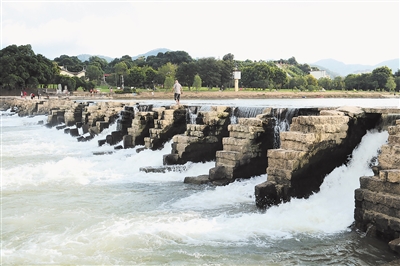
| The Mulanbei Water Conservation Project in Mulan, a village southwest of Putian city of Fujian province in southeast China, has been in operation for nearly 1,000 years. (PHOTO: VCG) |
The Mulanbei Water Conservation Project in Mulan, a village southwest of Putian city of Fujian province in southeast China, has been in operation for nearly 1,000 years. It adopted unique planning, design and construction techniques well ahead of its contemporaries to retain fresh water and resist saline water intrusion. The structure was completed in 1083.
It was designed for water retention, tide prevention, flood discharge, sand removal and water diversion. The location of the weir was chosen based on previous experience to perfectly balance the impact of upstream floods and downstream tidal surges. Due to its location on a weak riverbed near the ocean, the project's headwork structures included an overflow weir, a gravity dam, a diversion dike, a sluice gate, and diversion mouths on both riverbanks. The raft foundation alleviates pier pressure per unit area. The sluice foundation and the weir are made of local granite.
The gate walls or piers were built on the weir, and stone pillars inserted through the walls or piers into the riverbed base rock. Pig iron was then melted to fill the gaps. The pier stones of the weir and the gate stones were linked with shoe-shaped iron ingots. As such, the weir and the gate formed an integrated whole. The iron ingots were used to ensure the project operated effectively for more than 930 years. To this day, it retains its basic engineering construction from the historical period.
The Mulanbei Water Conservation Project has contributed to the development of the Xinghua Plain, a highly fertile coastal plain in Putian. It supplies water for industrial and agricultural production and domestic use, and also plays a part in shipping and aquaculture. It is especially important for flood defense. The project saw southern China's population increase and agriculture develop rapidly.
Mulanbei serves as a microcosm of Putian's historical development, providing a concrete example for the study of social change in the region. In September 2014, the International Commission on Irrigation and Drainage included this project in the inaugural list of World Heritage Irrigation Structures.