

 Next
Next


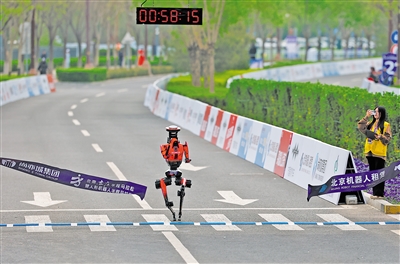 |
| ? The autonomous humanoid robot player Flash crosses the finish line in the E-Town half-marathon on April 19. (PHOTO: XINHUA) |
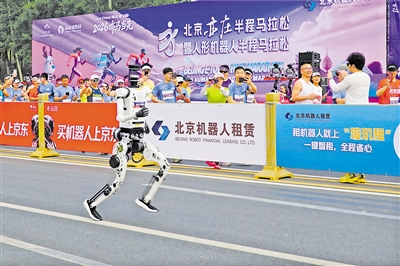 |
| ? A humanoid robot runs during the E-Town half-marathon on April 19. (PHOTO: ZHAO Weihua / Science and Technology Daily) |
"Flash," Shenzhen Honor Smart Technology Development Co., Ltd.'s humanoid robot capable of autonomous navigation, claimed victory at the 2026 Beijing E-Town half-marathon on April 19, with a time of 50 minutes and 26 seconds. It surpassed the human world record for a half-marathon by nearly seven minutes.
Such amazing performance on the track is a vivid example of the breakthroughs made by China's humanoid robot industry in multiple core technologies. Chinese humanoid robots are rapidly evolving in real-world applications and China now leads the global robot industry.
In this marathon, robots with fully autonomous navigation accounted for approximately 40 percent of the starting teams, a significant increase compared to last year. Some of the high-performing robots have achieved body tilting and smooth curve changes under high-speed conditions.
"It will certainly be interesting to see the progress in the durability of components and battery lifetime compared to last year," said Georg Stieler, Asia managing director and head of robotics at Stieler, a technology consultancy.
China has made significant breakthroughs in the control technology of humanoid robots, especially in autonomous motion control and stability.
Flash has been designed after elite athletes, with its long legs measuring about 37 inches. It also has an advanced cooling system to sustain performance.
"Looking ahead, some of these technologies might be transferred to other areas," said Du Xiaodi, an engineer with the Honor team. "For example, structural reliability and liquid-cooling technology could be applied in future industrial scenarios."
Fu Yili, a professor of Harbin Institute of Technology, attributed the leap from "remote-controlled waddling" to the "autonomous running" of humanoid robots to the joint efforts of hardware localization, algorithm optimization, and the development of the industrial ecosystem.
From a global perspective, China leads in terms of overall machine shipments, production capacity, supply chain completeness, and the speed of commercialization. It has become the "mass production and application center" of humanoid robots.
China dominates global humanoid robot installations, accounting for more than 80 percent of the 16,000 units installed worldwide in 2025, according to global technology market intelligence firm Counterpoint Research. Chinese robotics firms are now working to develop the AI software needed for humanoids to match the efficiency of human factory workers.
London-based technology research and advisory group Omdia recently ranked three Chinese companies — AGIBOT, Unitree Robotics and UBTech Robotics Corp. — as the only first-tier vendors in its global assessment for shipment numbers for general-purpose embodied intelligent robots. They all shipped more than 1,000 units of such robots last year, with the first two shipping more than 5,000 units, the report said.
The expansion of industrial scale implies an increase in the influence of technology. Yang Zhen, an associate research fellow of the Institute of Industrial Economics of the Chinese Academy of Social Sciences, said China is not only the world's largest producer of robots, it has also become an important source of technology.
The number of Chinese patents and enterprises account for over 60 percent of the global total. In the cutting-edge field of humanoid robots, Chinese enterprises' performance is almost "dominant."