


 |
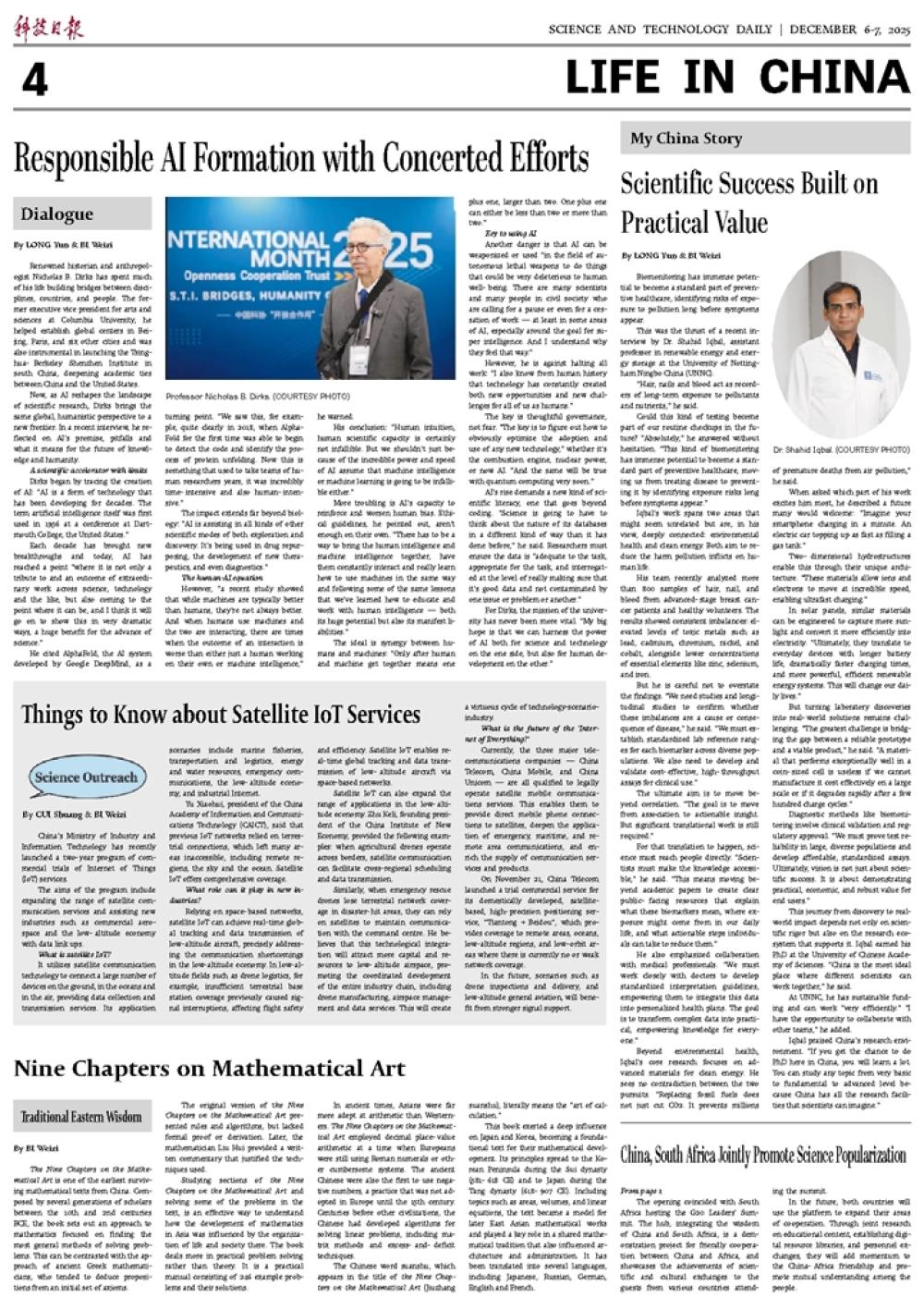
| Professor Nicholas B. Dirks. (COURTESY PHOTO) |
Renowned historian and anthropologist Nicholas B. Dirks has spent much of his life building bridges between disciplines, countries, and people. The former executive vice president for arts and sciences at Columbia University, he helped establish global centers in Beijing, Paris, and six other cities and was also instrumental in launching the Tsinghua-Berkeley Shenzhen Institute in south China, deepening academic ties between China and the United States.
Now, as AI reshapes the landscape of scientific research, Dirks brings the same global, humanistic perspective to a new frontier. In a recent interview, he reflected on AI's promise, pitfalls and what it means for the future of knowledge and humanity.
A scientific accelerator with limits
Dirks began by tracing the creation of AI: "AI is a form of technology that has been developing for decades. The term artificial intelligence itself was first used in 1956 at a conference at Dartmouth College, the United States."
Each decade has brought new breakthroughs and today, AI has reached a point "where it is not only a tribute to and an outcome of extraordinary work across science, technology and the like, but also coming to the point where it can be, and I think it will go on to show this in very dramatic ways, a huge benefit for the advance of science."
He cited AlphaFold, the AI system developed by Google DeepMind, as a turning point. "We saw this, for example, quite clearly in 2018, when AlphaFold for the first time was able to begin to detect the code and identify the process of protein unfolding. Now this is something that used to take teams of human researchers years, it was incredibly time-intensive and also human-intensive."
The impact extends far beyond biology: "AI is assisting in all kinds of other scientific modes of both exploration and discovery. It's being used in drug repurposing, the development of new therapeutics, and even diagnostics."
The human-AI equation
However, "a recent study showed that while machines are typically better than humans, they're not always better. And when humans use machines and the two are interacting, there are times when the outcome of an interaction is worse than either just a human working on their own or machine intelligence," he warned.
His conclusion: "Human intuition, human scientific capacity is certainly not infallible. But we shouldn't just because of the incredible power and speed of AI assume that machine intelligence or machine learning is going to be infallible either."
More troubling is AI's capacity to reinforce and worsen human bias. Ethical guidelines, he pointed out, aren't enough on their own. "There has to be a way to bring the human intelligence and machine intelligence together, have them constantly interact and really learn how to use machines in the same way and following some of the same lessons that we've learned how to educate and work with human intelligence — both its huge potential but also its manifest liabilities."
The ideal is synergy between humans and machines: "Only after human and machine get together means one plus one, larger than two. One plus one can either be less than two or more than two."
Key to using AI
Another danger is that AI can be weaponized or used "in the field of autonomous lethal weapons to do things that could be very deleterious to human well-being. There are many scientists and many people in civil society who are calling for a pause or even for a cessation of work — at least in some areas of AI, especially around the goal for super intelligence. And I understand why they feel that way."
However, he is against halting all work: "I also know from human history that technology has constantly created both new opportunities and new challenges for all of us as humans."
The key is thoughtful governance, not fear. "The key is to figure out how to obviously optimize the adoption and use of any new technology," whether it's the combustion engine, nuclear power, or now AI. "And the same will be true with quantum computing very soon."
AI's rise demands a new kind of scientific literacy, one that goes beyond coding. "Science is going to have to think about the nature of its databases in a different kind of way than it has done before," he said. Researchers must ensure the data is "adequate to the task, appropriate for the task, and interrogated at the level of really making sure that it's good data and not contaminated by one issue or problem or another."
For Dirks, the mission of the university has never been more vital. "My big hope is that we can harness the power of AI both for science and technology on the one side, but also for human development on the other."