


 |
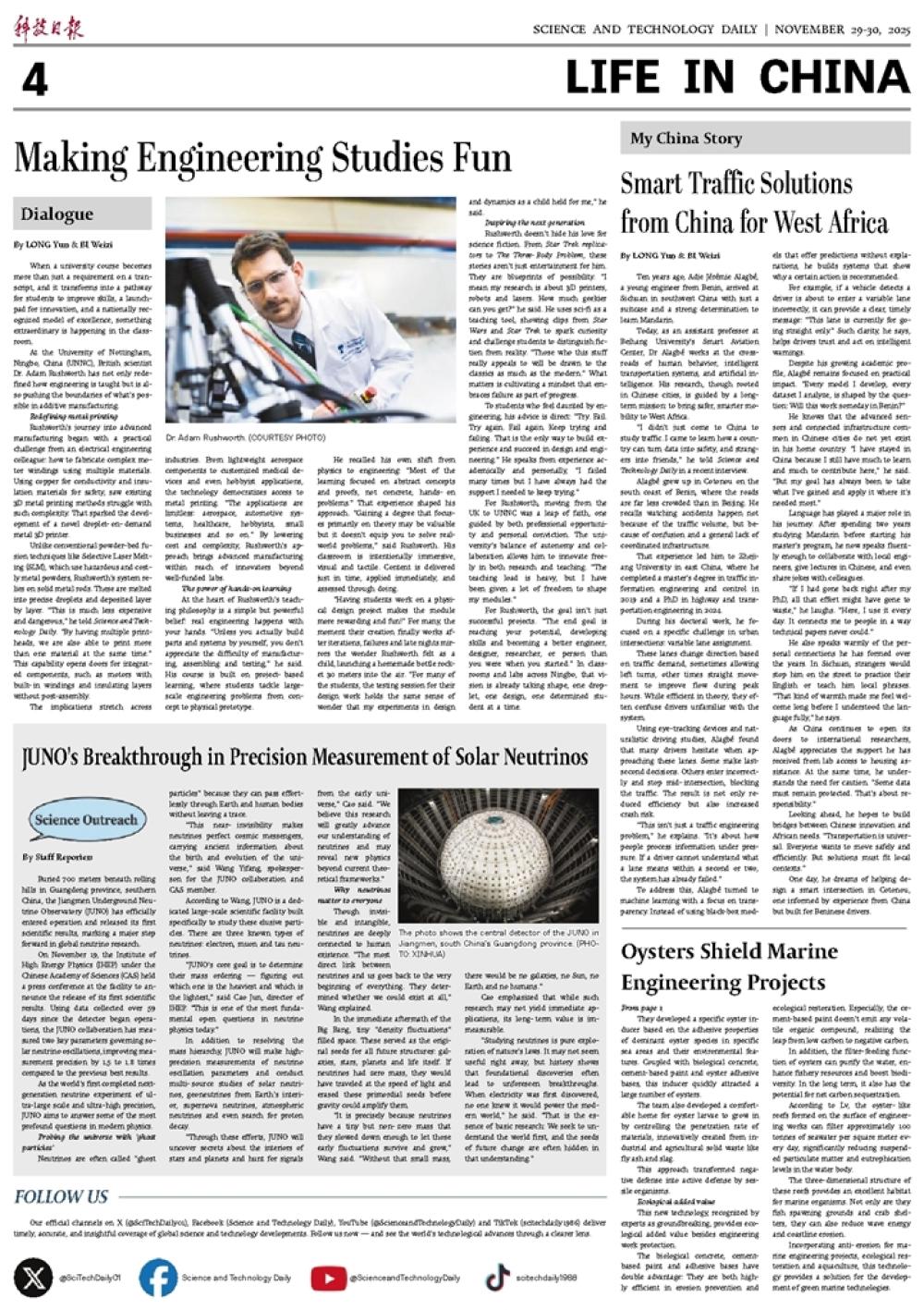
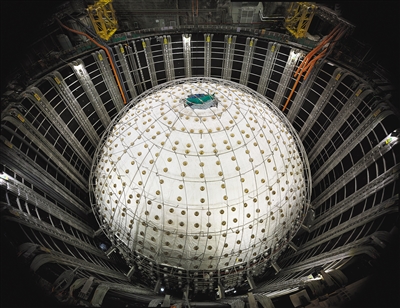
| The photo shows the central detector of the JUNO in Jiangmen, south China's Guangdong province. (PHOTO: XINHUA) |
Buried 700 meters beneath rolling hills in Guangdong province, southern China, the Jiangmen Underground Neutrino Observatory (JUNO) has officially entered operation and released its first scientific results, marking a major step forward in global neutrino research.
On November 19, the Institute of High Energy Physics (IHEP) under the Chinese Academy of Sciences (CAS) held a press conference at the facility to announce the release of its first scientific results. Using data collected over 59 days since the detector began operations, the JUNO collaboration has measured two key parameters governing solar neutrino oscillations, improving measurement precision by 1.5 to 1.8 times compared to the previous best results.
As the world's first completed next-generation neutrino experiment of ultra-large scale and ultra-high precision, JUNO aims to answer some of the most profound questions in modern physics.
Probing the universe with 'ghost particles'
Neutrinos are often called "ghost particles" because they can pass effortlessly through Earth and human bodies without leaving a trace.
"This near-invisibility makes neutrinos perfect cosmic messengers, carrying ancient information about the birth and evolution of the universe," said Wang Yifang, spokesperson for the JUNO collaboration and CAS member.
According to Wang, JUNO is a dedicated large-scale scientific facility built specifically to study these elusive particles. There are three known types of neutrinos: electron, muon and tau neutrinos.
"JUNO's core goal is to determine their mass ordering — figuring out which one is the heaviest and which is the lightest," said Cao Jun, director of IHEP. "This is one of the most fundamental open questions in neutrino physics today."
In addition to resolving the mass hierarchy, JUNO will make high-precision measurements of neutrino oscillation parameters and conduct multi-source studies of solar neutrinos, geoneutrinos from Earth's interior, supernova neutrinos, atmospheric neutrinos and even search for proton decay.
"Through these efforts, JUNO will uncover secrets about the interiors of stars and planets and hunt for signals from the early universe," Cao said. "We believe this research will greatly advance our understanding of neutrinos and may reveal new physics beyond current theoretical frameworks."
Why neutrinos matter to everyone
Though invisible and intangible, neutrinos are deeply connected to human existence. "The most direct link between neutrinos and us goes back to the very beginning of everything. They determined whether we could exist at all," Wang explained.
In the immediate aftermath of the Big Bang, tiny "density fluctuations" filled space. These served as the original seeds for all future structures: galaxies, stars, planets and life itself. If neutrinos had zero mass, they would have traveled at the speed of light and erased those primordial seeds before gravity could amplify them.
"It is precisely because neutrinos have a tiny but non-zero mass that they slowed down enough to let those early fluctuations survive and grow," Wang said. "Without that small mass, there would be no galaxies, no Sun, no Earth and no humans."
Cao emphasized that while such research may not yield immediate applications, its long-term value is immeasurable.
"Studying neutrinos is pure exploration of nature's laws. It may not seem useful right away, but history shows that foundational discoveries often lead to unforeseen breakthroughs. When electricity was first discovered, no one knew it would power the modern world," he said. "That is the essence of basic research: We seek to understand the world first, and the seeds of future change are often hidden in that understanding."