


 |
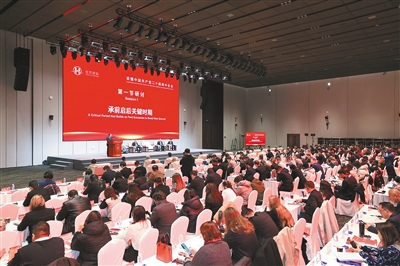
| The symposium titled "Understanding the Fourth Plenary Session of the 20th Central Committee of the Communist Party of China" is held in Beijing on November 7. (PHOTO: XINHUA) |
A think tank report released on November 7 elaborates on the strategic layout of China's economic and social development during the 15th Five-Year Plan period (2026-2030).
The report was made public in Beijing at a symposium co-hosted by the national high-level think tanks of the Central Institute of Party History and Literature and the Xinhua News Agency.
Addressing the symposium, Qu Qingshan, head of the Central Institute of Party History and Literature, noted that the Party leadership's recommendations for formulating the 15th Five-Year Plan, adopted at the fourth plenary session of the 20th CPC Central Committee, serve as another mobilization and overall deployment to advance Chinese modernization.
In his speech, Fu Hua, president of Xinhua News Agency, said the think tank report represents the latest research achievement, based on a deep understanding of the guiding principles from the plenum. "It seeks to interpret the wisdom that continues to guide China's modernization journey," he added.
The international participants at the symposium also gave their perspectives on China's development model, underscoring its global relevance and distinctive characteristics.
Alberto Blanco Silva, Cuban ambassador to China, emphasized that China's development is not just about growth. It is also about stability, vision and the people. China's commitment to socialist modernization serves as a stabilizing force amid global uncertainty.
The ambassador also praised China's vision of a community with a shared future for humanity, especially its contributions to South-South cooperation and more equitable global governance.
Anna Malindog-Uy, director and vice president of external affairs at the Asian Century Philippines Strategic Studies Institute, described China's modernization as a long-term historical process. She noted achievements in sci-tech field, rural revitalization and ecological civilization. She praised China's openness to the world through endeavors such as the Belt and Road Initiative. "China's development is not closed or exclusive," she said. "It offers opportunities for other developing countries."
Several foreign experts who have lived and worked in China for decades shared their firsthand observations of how China turns plans into reality.
Mustafa Mohamed Ahmed Yahia, Arabic expert at the Institute of Party History and Literature, has lived in China for over 30 years. He has observed six Five-Year Plans from beginning to implementation."I have seen with my own eyes how China has transformed," he said. For him, the strength of China's planning lies in execution. "These are not just documents," he said. "They are action plans carried out year after year with consistency and discipline." From infrastructure to digital economy, from rural development to urban innovation, he has witnessed how policy translates into real improvements in people's lives.
Elena Kazanina, Russian expert at the Institute of Party History and Literature, spoke about the depth and continuity of China's governance philosophy. She has noted how the core principles remain stable across time. "What stands out is not only the pace of change but the consistency of direction," she said. "China's modernization is not copied from others. It is shaped by its own history, culture and socialist path."
The discussions at the forum reflected a growing international understanding of China's development, which is the result of long-term planning, strong institutions and a clear strategic vision. In a world facing turbulence, China's path offers stability, coherence and hope.