

 Next
Next


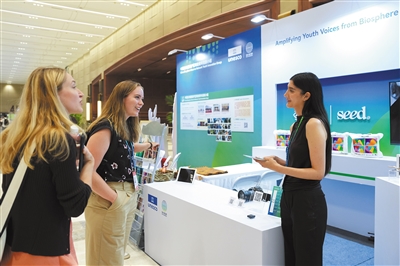 |
| Representatives interact during the 5th WCBR in Hangzhou, Zhejiang province. (PHOTO: XINHUA) |
The Fifth World Congress of Biosphere Reserves (WCBR) to advance global biodiversity protection and sustainable development was held in Hangzhou, Zhejiang province in east China, from September 22 to 25. Held in Asia for the first time, it was the most widely attended gathering of UNESCO member states, bringing together nearly 4,000 representatives from more than 150 countries.
The UNESCO Man and the Biosphere (MAB) Programme, established in 1971, promotes the sustainable management of biodiversity and human-nature interactions through the World Network of Biosphere Reserves.
UNESCO convenes the WCBR every 10 years to evaluate progress, share experiences and set future directions for the MAB Programme. The last WCBR was held in Lima, Peru in 2016, where the Lima Action Plan (2016-2025) was adopted.
China joined the MAB Programme in 1973 and established the Chinese National Committee for MAB Programme (MAB China). The Chinese Academy of Sciences (CAS) in Beijing, where the secretariat of MAB China is located, collaborates with others to advance the protection work through the Chinese Biosphere Reserves Network, achieving significant results.
The construction of national parks and national botanical gardens and implementation of wildlife protection programs has led to stable increase in a large batch of rare and endangered species populations, such as pandas, Tibetan antelopes and Yangtze finless porpoises, and their habitats have been improved.
Wang Ding, secretary general of MAB China, said strengthening biosphere protection is critical not only for global ecological security, but for the sustainable development of human beings. China has 34 nature reserves recognized as UNESCO biosphere reserves, ranking first in Asia. These nature reserves have become key platforms for frontier exploration and international cooperation in biodiversity protection, ecosystem maintenance, sustainable utilization of natural resources and coordinated development of protection zones and communities.
The construction and development of biosphere reserves not only provides crucial application scenarios for new ideas, new technologies and new products, but also establishes key platforms for countries to jointly strengthen cooperation in ecological protection and realize common sustainable development, CAS President Hou Jianguo said at the conference.
In order to deepen sci-tech cooperation and better empower the construction of biosphere reserves, Hou suggested promoting joint research in key areas, strengthening the joint construction and sharing of basic capabilities, and extending technological application scenarios unitedly.
Guo Huadong, a CAS academician, proposed establishing a theoretical framework and prediction models for the dynamic changes of the biosphere ecosystem, providing a scientific basis for protection strategies.
He also suggested using earth observation systems like satellite remote sensing for continuous monitoring of biosphere reserves.