

 Next
Next


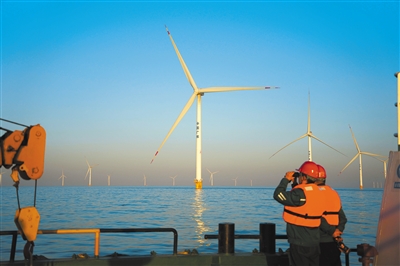 |
| The photo taken on January 7, 2025, shows the offshore wind power project area of Laizhou city, Shandong province. (PHOTO: XINHUA) |
A recent State Council report, submitted to the Standing Committee of the National People's Congress of China for deliberation, detailed substantial progress in achieving the country's carbon peak and carbon neutrality goals. The report underscores China's rapidly expanding renewable energy capacity, sustained declines in carbon intensity, and growing role in supporting global climate action through both domestic achievements and international cooperation.
Data reveals that China has established the world's largest and fastest-growing renewable energy system, along with the most comprehensive new energy industrial chain. The total installed capacity of wind and solar power and forest stock have already met the 2030 nationally determined contributions targets ahead of schedule. From 2012 to 2023, China's carbon dioxide emissions per unit of GDP decreased by over 35 percent. These figures demonstrate the substantial progress China has made in synergizing high-quality economic development with green transformation.
Energy structure transformation is central to achieving the "dual carbon" goal. China has made consistent progress in its energy revolution, continuously increasing the share of non-fossil energy consumption, while systematically reducing the share of coal consumption.
Currently, China leads the world in installed wind and solar power capacity, with accelerating developments in hydrogen energy and new energy storage technologies. These developments have not only made a huge dent in carbon intensity but have also contributed greatly to the global scaling and cost reduction of new energy technologies.
China's national carbon emissions trading market, now the largest of its kind in the world, has become a pivotal mechanism for incentivizing emission reductions among power producers and soon to expand industrial sectors. Concordantly, large-scale afforestation and ecological conservation programs have significantly increased carbon sinks. China now accounts for one-quarter of the world's new green area, with forest stock volume exceeding earlier projections.
In addition to domestic initiatives, China has actively engaged in climate focused South-South cooperation. It has signed 53 memoranda of understanding with 42 developing countries, supporting projects that include low-carbon demonstration zones, disaster-resistant agriculture, and climate adaptation infrastructure. These initiatives highlight the fact that China is taking proactive domestic measures, while also being a cooperating partner aiding other nations.
Despite the achievements, challenges remain. Key tasks ahead include transforming energy-intensive industries, improving grid flexibility to accommodate renewable intermittency, and fostering green technological innovation. The intensive decarbonization of steel, cement, and chemical sectors will require both policy precision and market incentives.
China's "dual carbon" journey is not only integral to its own sustainable development, but also a critical practice in building a global community with a shared future. Within the multilateral process of global climate governance, China continues to demonstrate leadership and responsibility, injecting confidence and momentum into collective efforts to address global climate change.