
 Next
Next


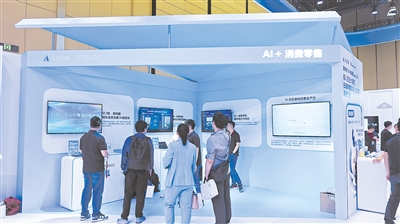 |
| Participants visit a booth at the Force Original Power Conference held by ByteDance's Volcano Engine in Beijing. (PHOTO: VCG) |
 |
As Beijing gears up to become a global hub for AI innovation and industrial development, it has released a three-year roadmap to foster an open-source, competitive ecosystem that can support the growth of a world-class AI-driven science industry cluster.
The Action Plan for Accelerating High-Quality Development of AI for Science in Beijing (2025—2027) is China's first local policy dedicated to "AI for Science."
It was jointly released by Beijing Municipal Science and Technology Commission, Administrative Committee of Zhongguancun Science Park, Beijing Municipal Commission of Development and Reform Commission, and Beijing Municipal Bureau of Economy and Information Technology, together with the Haidian District Government.
The action plan emphasizes cutting-edge R&D and the integration of AI into scientific disciplines. It introduces 17 targeted tasks across four priority areas: key technology breakthroughs, infrastructure development, practical applications, and the creation of an open innovation ecosystem.
By 2027, Beijing aims to develop scientific foundation models, establish at least 10 high-quality scientific databases serving over 10 million users, and enable AI applications in no fewer than five major scientific fields.
It also plans to produce over eight exemplary application cases, build a common service platform, and nurture interdisciplinary talent. A multi-channel financing and investment service system will be built while international collaboration will be promoted.
Beijing has been advancing AI for Science as a strategic pillar of its AI development. In 2021, the city established the AI for Science Institute, the first Chinese research institution focusing entirely on AI for Science. Since then, it has delivered a series of landmark achievements, including the Deep Potential Atom model — covering over 90 chemical elements, and the Bohrium Space Station, an AI-powered research cloud platform that integrates literature review, computing, lab experimentation, and interdisciplinary collaboration.
For effective implementation of the plan, Beijing will introduce additional targeted policies in areas such as AI + new materials and AI + medicare. These measures will promote coordinated resource allocation and reinforce strategic momentum across key sectors.
Along with this, a dedicated task force for AI for Science will be established. The team will oversee major projects in core technologies, infrastructure, and applied research, while encouraging joint innovation among ecosystem stakeholders.