
 Next
Next


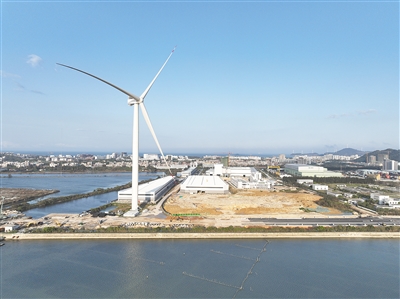 |
| The offshore wind power equipment manufacturing industrial park in Shantou, Guangdong province. (PHOTO: VCG) |
To close the gap in domestic high-capacity wind turbine testing and support its new energy sector, China Southern Power Grid's Guangdong Power Grid Company began construction of the country's first nearshore wind power testing base in 2022. Designed as a public certification and testing platform for large-scale offshore turbines, the facility now has two test turbines ready with the test capacity up to 24 megawatts for a single turbine, which is among the highest globally.
Guangdong has led China in marine economic output for 30 consecutive years, surpassing two trillion RMB in 2024, with offshore wind being a key driver in this success. As of this June, Guangdong's installed capacity reached 12.51 million kilowatts, ranking first nationwide. One in every three offshore turbines in China is made in Guangdong.
Expanding projects, boosting capacity
In Shantou's Nan'ao Island, rows of turbines power Guangdong's energy transition. Developed by Datang Shantou New Energy Co., Ltd., the Nan'ao Lemeng I wind farm began operating in 2021 and has generated about 2.8 billion kWh. Its expansion has now been fully connected to the grid, becoming Shantou's third offshore wind project.
"This is our largest single-turbine capacity project. It's the first in eastern Guangdong to deploy 13 MW turbines at scale and to introduce 16 MW turbines," said Lou Shujun, the executive director of Datang Shantou New Energy Co., Ltd. According to Lou, the site also integrates marine ranching, with structures that can withstand typhoons up to Level 16.
In Yangjiang, Guangdong province, China's first integrated land-sea flexible DC transmission project is underway. Scheduled for completion in 2026, the Sanshan Island project will deliver six billion kWh of clean energy annually to the Guangdong-Hong Kong-Macao Greater Bay Area through a "deep-sea power expressway."
Guangdong's offshore wind industry now spans the full chain — R&D, manufacturing, installation and maintenance. Since the 14th Five-Year Plan began, the province has added over one million kilowatts grid-connected capacity for four consecutive years, with total installed capacity surpassing 12.5 million kilowatts. Major industry hubs are already operational.
Though Guangdong was a late starter in the marine economy, its long coastline, abundant resources and continuous innovation give it strong potential, Lou said.
Advancing innovation, targeting deep seas
Offshore wind in Guangdong is extending into deeper waters with global firsts such as the "Haiyou Guanlan" floating turbine, and the world's first dual-rotor floating energy island.
A key development is the dual-rotor floating platform by Mingyang Smart Energy Group, which mounts two 8.3 MW turbines and operates over 70 km offshore. "We've built a full innovation chain — from research to application," said Zhang Chuanwei, chairman of Mingyang Smart Energy Group. Their platform uses AI systems, smart monitoring, and forecasting tools to reduce costs and improve efficiency in deep-sea deployment.
Guangdong now hosts over 100 marine-related R&D labs and centers. Key technologies in deep-sea science and marine ecology have advanced rapidly. Both Mingyang Smart Energy Group's floating turbine technology and Guangdong Hydropower's offshore construction capabilities meet international standards.
Guangdong's offshore wind growth is underpinned by strong policy support. A 2018 development plan outlined large-scale offshore wind expansion through to 2030. Follow-up policies supported orderly development, deep-sea innovation, and supply chain improvement.
The Regulations of Guangdong Province on Promoting High-Quality Development of Marine Economy, in effect since July 2025, encourages deeper-sea projects, floating turbine technology, and base construction. The 2025 Action Plan for Building a Modern Industrial System in Guangdong Province further promotes the differentiated growth of offshore wind hubs in cities like Shantou and Yangjiang.
Shantou's International Wind Power Innovation Port, built by provincial and local governments, is now a national hub. An integrated industrial park is in operation, attracting top domestic companies, while a 40 MW-class experimental platform is under construction.