


 |
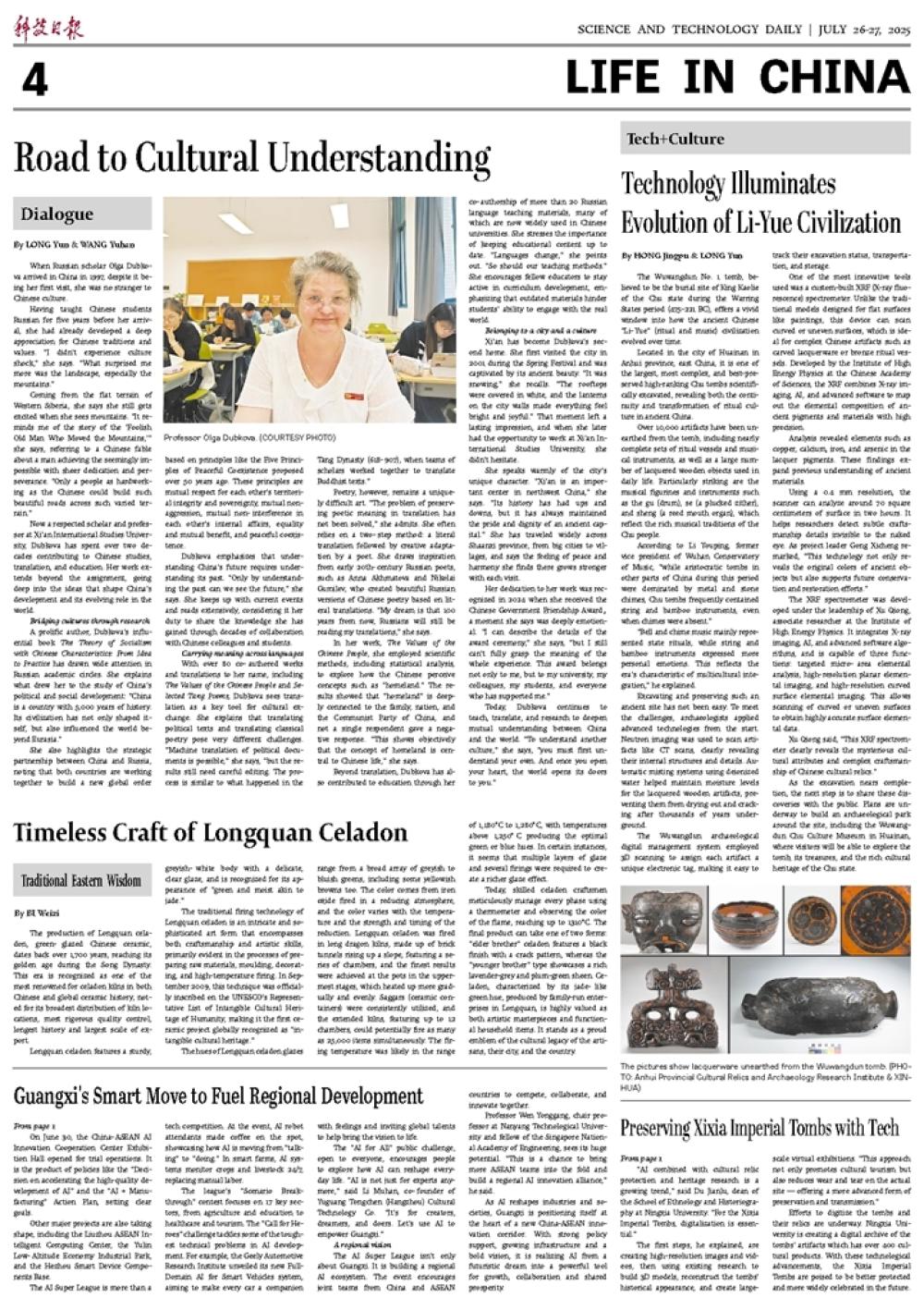
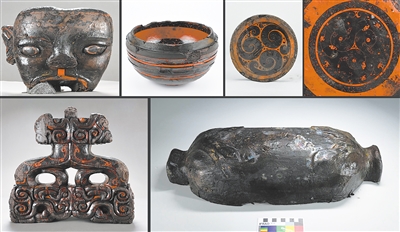
| The pictures show lacquerware unearthed from the Wuwangdun tomb. (PHOTO: Anhui Provincial Cultural Relics and Archaeology Research Institute & XINHUA) |
The Wuwangdun No. 1 tomb, believed to be the burial site of King Kaolie of the Chu state during the Warring States period (475-221 BC), offers a vivid window into how the ancient Chinese "Li-Yue" (ritual and music) civilization evolved over time.
Located in the city of Huainan in Anhui province, east China, it is one of the largest, most complex, and best-preserved high-ranking Chu tombs scientifically excavated, revealing both the continuity and transformation of ritual culture in ancient China.
Over 10,000 artifacts have been unearthed from the tomb, including nearly complete sets of ritual vessels and musical instruments, as well as a large number of lacquered wooden objects used in daily life. Particularly striking are the musical figurines and instruments such as the gu (drum), se (a plucked zither), and sheng (a reed mouth organ), which reflect the rich musical traditions of the Chu people.
According to Li Youping, former vice president of Wuhan Conservatory of Music, "while aristocratic tombs in other parts of China during this period were dominated by metal and stone chimes, Chu tombs frequently contained string and bamboo instruments, even when chimes were absent."
"Bell and chime music mainly represented state rituals, while string and bamboo instruments expressed more personal emotions. This reflects the era's characteristic of multicultural integration," he explained.
Excavating and preserving such an ancient site has not been easy. To meet the challenges, archaeologists applied advanced technologies from the start. Neutron imaging was used to scan artifacts like CT scans, clearly revealing their internal structures and details. Automatic misting systems using deionized water helped maintain moisture levels for the lacquered wooden artifacts, preventing them from drying out and cracking after thousands of years underground.
The Wuwangdun archaeological digital management system employed 3D scanning to assign each artifact a unique electronic tag, making it easy to track their excavation status, transportation, and storage.
One of the most innovative tools used was a custom-built XRF (X-ray fluorescence) spectrometer. Unlike the traditional models designed for flat surfaces like paintings, this device can scan curved or uneven surfaces, which is ideal for complex Chinese artifacts such as carved lacquerware or bronze ritual vessels. Developed by the Institute of High Energy Physics at the Chinese Academy of Sciences, the XRF combines X-ray imaging, AI, and advanced software to map out the elemental composition of ancient pigments and materials with high precision.
Analysis revealed elements such as copper, calcium, iron, and arsenic in the lacquer pigments. These findings expand previous understanding of ancient materials.
Using a 0.4 mm resolution, the scanner can analyze around 70 square centimeters of surface in two hours. It helps researchers detect subtle craftsmanship details invisible to the naked eye. As project leader Gong Xicheng remarked, "This technology not only reveals the original colors of ancient objects but also supports future conservation and restoration efforts."
The XRF spectrometer was developed under the leadership of Xu Qiong, associate researcher at the Institute of High Energy Physics. It integrates X-ray imaging, AI, and advanced software algorithms, and is capable of three functions: targeted micro-area elemental analysis, high-resolution planar elemental imaging, and high-resolution curved surface elemental imaging. This allows scanning of curved or uneven surfaces to obtain highly accurate surface elemental data.
Xu Qiong said, "This XRF spectrometer clearly reveals the mysterious cultural attributes and complex craftsmanship of Chinese cultural relics."
As the excavation nears completion, the next step is to share these discoveries with the public. Plans are underway to build an archaeological park around the site, including the Wuwangdun Chu Culture Museum in Huainan, where visitors will be able to explore the tomb, its treasures, and the rich cultural heritage of the Chu state.