


 |
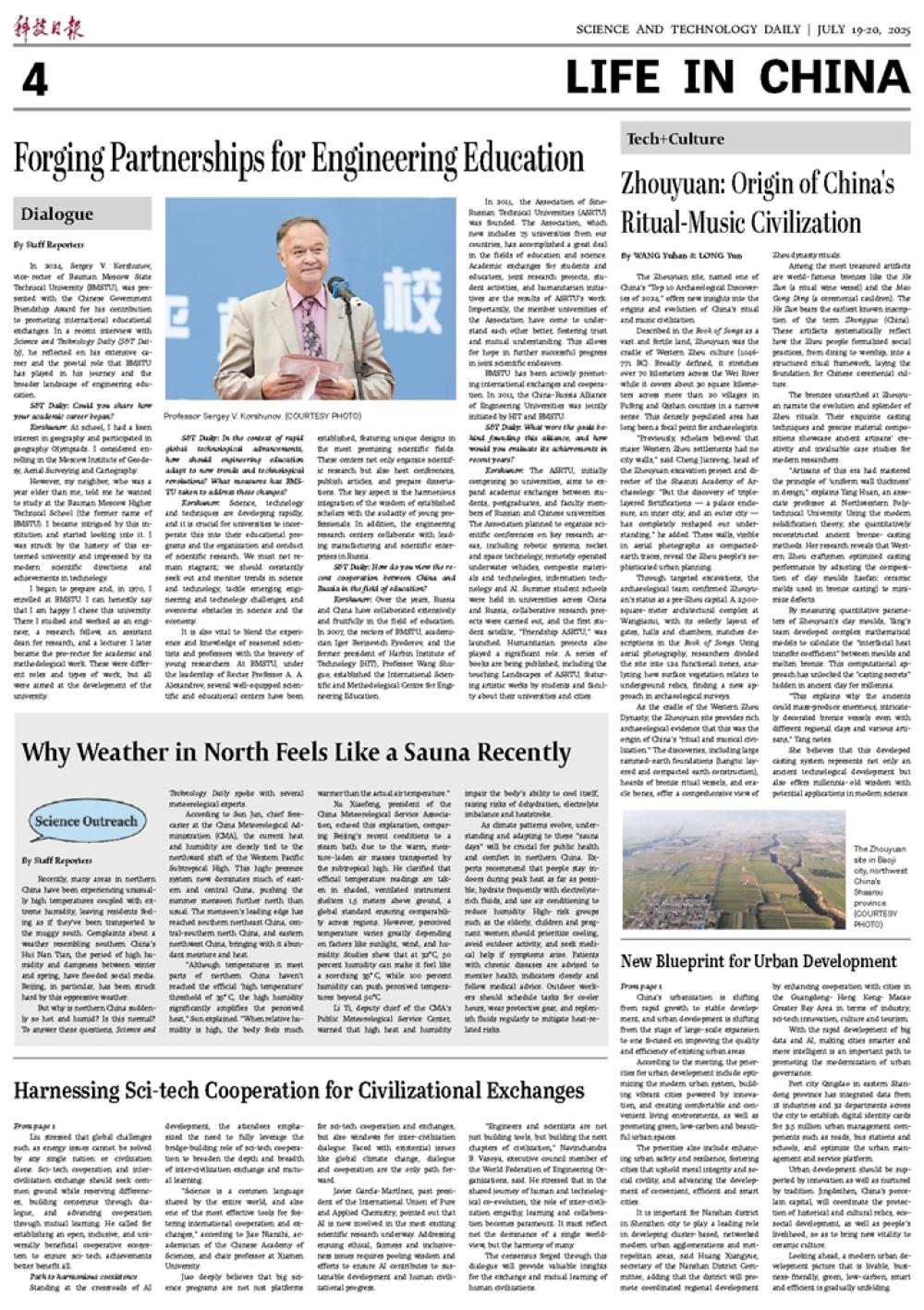
| Professor Sergey V. Korshunov. (COURTESY PHOTO) |
In 2024, Sergey V. Korshunov, vice-rector of Bauman Moscow State Technical University (BMSTU), was presented with the Chinese Government Friendship Award for his contribution to promoting international educational exchanges. In a recent interview with Science and Technology Daily (S&T Daily), he reflected on his extensive career and the pivotal role that BMSTU has played in his journey and the broader landscape of engineering education.
S&T Daily: Could you share how your academic career began?
Korshunov: At school, I had a keen interest in geography and participated in geography Olympiads. I considered enrolling in the Moscow Institute of Geodesy, Aerial Surveying and Cartography.
However, my neighbor, who was a year older than me, told me he wanted to study at the Bauman Moscow Higher Technical School (the former name of BMSTU). I became intrigued by this institution and started looking into it. I was struck by the history of this esteemed university and impressed by its modern scientific directions and achievements in technology.
I began to prepare and, in 1970, I enrolled at BMSTU. I can honestly say that I am happy I chose this university. There I studied and worked as an engineer, a research fellow, an assistant dean for research, and a lecturer. I later became the pro-rector for academic and methodological work. These were different roles and types of work, but all were aimed at the development of the university.
S&T Daily: In the context of rapid global technological advancements, how should engineering education adapt to new trends and technological revolutions? What measures has BMSTU taken to address these changes?
Korshunov: Science, technology and techniques are developing rapidly, and it is crucial for universities to incorporate this into their educational programs and the organization and conduct of scientific research. We must not remain stagnant; we should constantly seek out and monitor trends in science and technology, tackle emerging engineering and technology challenges, and overcome obstacles in science and the economy.
It is also vital to blend the experience and knowledge of seasoned scientists and professors with the bravery of young researchers. At BMSTU, under the leadership of Rector Professor A. A. Alexandrov, several well-equipped scientific and educational centers have been established, featuring unique designs in the most promising scientific fields. These centers not only organize scientific research but also host conferences, publish articles, and prepare dissertations. The key aspect is the harmonious integration of the wisdom of established scholars with the audacity of young professionals. In addition, the engineering research centers collaborate with leading manufacturing and scientific enterprises in Russia.
S&T Daily: How do you view the recent cooperation between China and Russia in the field of education?
Korshunov: Over the years, Russia and China have collaborated extensively and fruitfully in the field of education. In 2007, the rectors of BMSTU, academician Igor Borisovich Fyodorov, and the former president of Harbin Institute of Technology (HIT), Professor Wang Shuguo, established the International Scientific and Methodological Centre for Engineering Education.
In 2011, the Association of Sino-Russian Technical Universities (ASRTU) was founded. The Association, which now includes 75 universities from our countries, has accomplished a great deal in the fields of education and science. Academic exchanges for students and educators, joint research projects, student activities, and humanitarian initiatives are the results of ASRTU's work. Importantly, the member universities of the Association have come to understand each other better, fostering trust and mutual understanding. This allows for hope in further successful progress in joint scientific endeavors.
BMSTU has been actively promoting international exchanges and cooperation. In 2011, the China-Russia Alliance of Engineering Universities was jointly initiated by HIT and BMSTU.
S&T Daily: What were the goals behind founding this alliance, and how would you evaluate its achievements in recent years?
Korshunov: The ASRTU, initially comprising 30 universities, aims to expand academic exchanges between students, postgraduates, and faculty members of Russian and Chinese universities. The Association planned to organize scientific conferences on key research areas, including robotic systems, rocket and space technology, remotely operated underwater vehicles, composite materials and technologies, information technology and AI. Summer student schools were held in universities across China and Russia, collaborative research projects were carried out, and the first student satellite, "Friendship ASRTU," was launched. Humanitarian projects also played a significant role. A series of books are being published, including the touching Landscapes of ASRTU, featuring artistic works by students and faculty about their universities and cities.