
 Next
Next


Editor's Note:
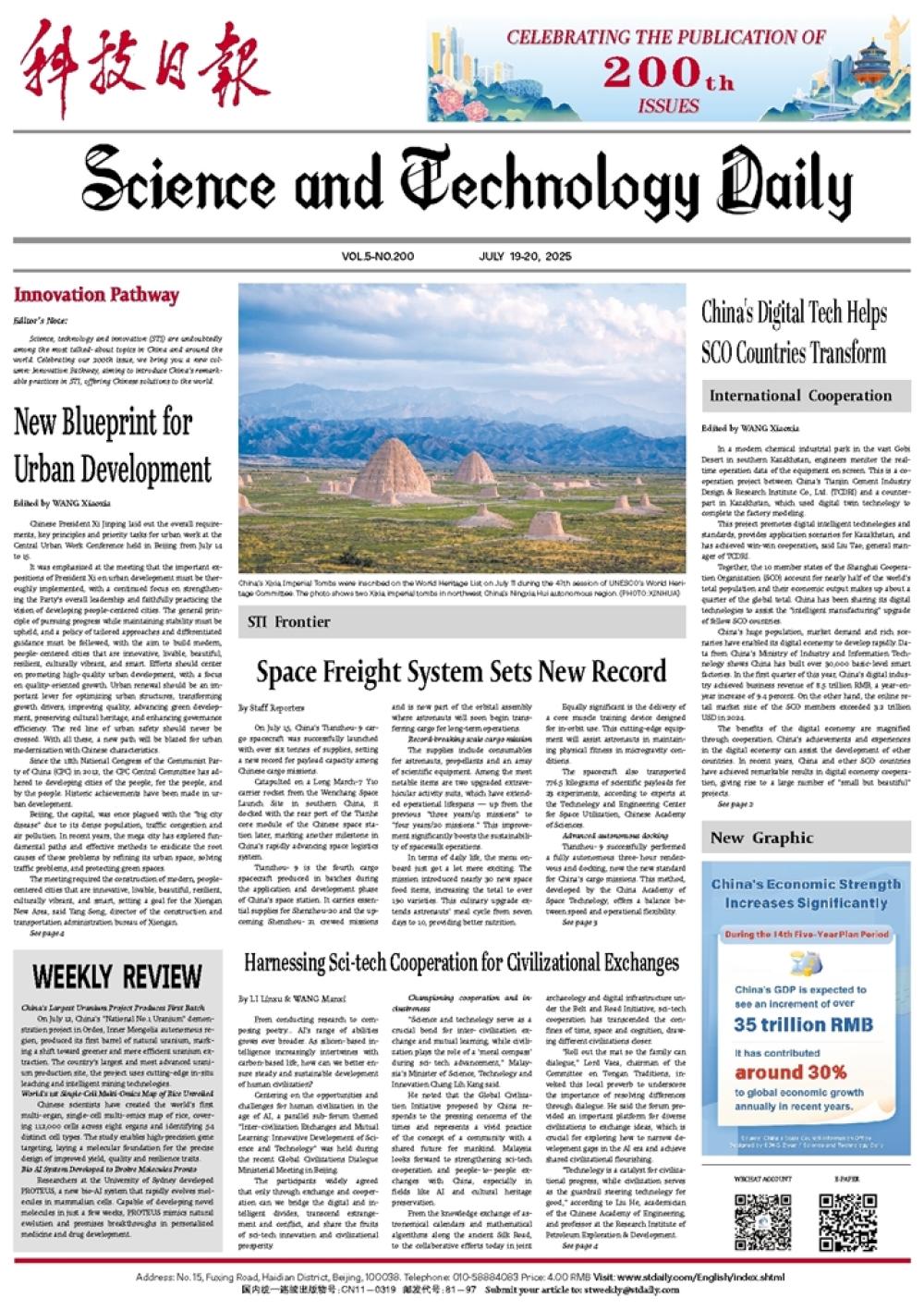
Science, technology and innovation (STI) are undoubtedly among the most talked-about topics in China and around the world. Celebrating our 200th issue, we bring you a new column: Innovation Pathway, aiming to introduce China's remarkable practices in STI, offering Chinese solutions to the world.
Chinese President Xi Jinping laid out the overall requirements, key principles and priority tasks for urban work at the Central Urban Work Conference held in Beijing from July 14 to 15.
It was emphasized at the meeting that the important expositions of President Xi on urban development must be thoroughly implemented, with a continued focus on strengthening the Party's overall leadership and faithfully practicing the vision of developing people-centered cities. The general principle of pursuing progress while maintaining stability must be upheld, and a policy of tailored approaches and differentiated guidance must be followed, with the aim to build modern, people-centered cities that are innovative, livable, beautiful, resilient, culturally vibrant, and smart. Efforts should center on promoting high-quality urban development, with a focus on quality-oriented growth. Urban renewal should be an important lever for optimizing urban structures, transforming growth drivers, improving quality, advancing green development, preserving cultural heritage, and enhancing governance efficiency. The red line of urban safety should never be crossed. With all these, a new path will be blazed for urban modernization with Chinese characteristics.
Since the 18th National Congress of the Communist Party of China (CPC) in 2012, the CPC Central Committee has adhered to developing cities of the people, for the people, and by the people. Historic achievements have been made in urban development.
Beijing, the capital, was once plagued with the "big city disease" due to its dense population, traffic congestion and air pollution. In recent years, the mega city has explored fundamental paths and effective methods to eradicate the root causes of those problems by refining its urban space, solving traffic problems, and protecting green spaces.
The meeting required the construction of modern, people-centered cities that are innovative, livable, beautiful, resilient, culturally vibrant, and smart, setting a goal for the Xiongan New Area, said Yang Song, director of the construction and transportation administration bureau of Xiongan.
China's urbanization is shifting from rapid growth to stable development, and urban development is shifting from the stage of large-scale expansion to one focused on improving the quality and efficiency of existing urban areas.
According to the meeting, the priorities for urban development include optimizing the modern urban system, building vibrant cities powered by innovation, and creating comfortable and convenient living environments, as well as promoting green, low-carbon and beautiful urban spaces.
The priorities also include enhancing urban safety and resilience, fostering cities that uphold moral integrity and social civility, and advancing the development of convenient, efficient and smart cities.
It is important for Nanshan district in Shenzhen city to play a leading role in developing cluster-based, networked modern urban agglomerations and metropolitan areas, said Huang Xiangyue, secretary of the Nanshan District Committee, adding that the district will promote coordinated regional development by enhancing cooperation with cities in the Guangdong-Hong Kong-Macao Greater Bay Area in terms of industry, sci-tech innovation, culture and tourism.
With the rapid development of big data and AI, making cities smarter and more intelligent is an important path to promoting the modernization of urban governance.
Port city Qingdao in eastern Shandong province has integrated data from 18 industries and 32 departments across the city to establish digital identity cards for 3.5 million urban management components such as roads, bus stations and schools, and optimize the urban management and service platform.
Urban development should be supported by innovation as well as nurtured by tradition. Jingdezhen, China's porcelain capital, will coordinate the protection of historical and cultural relics, eco-social development, as well as people's livelihood, so as to bring new vitality to ceramic culture.
Looking ahead, a modern urban development picture that is livable, business-friendly, green, low-carbon, smart and efficient is gradually unfolding.