

 |
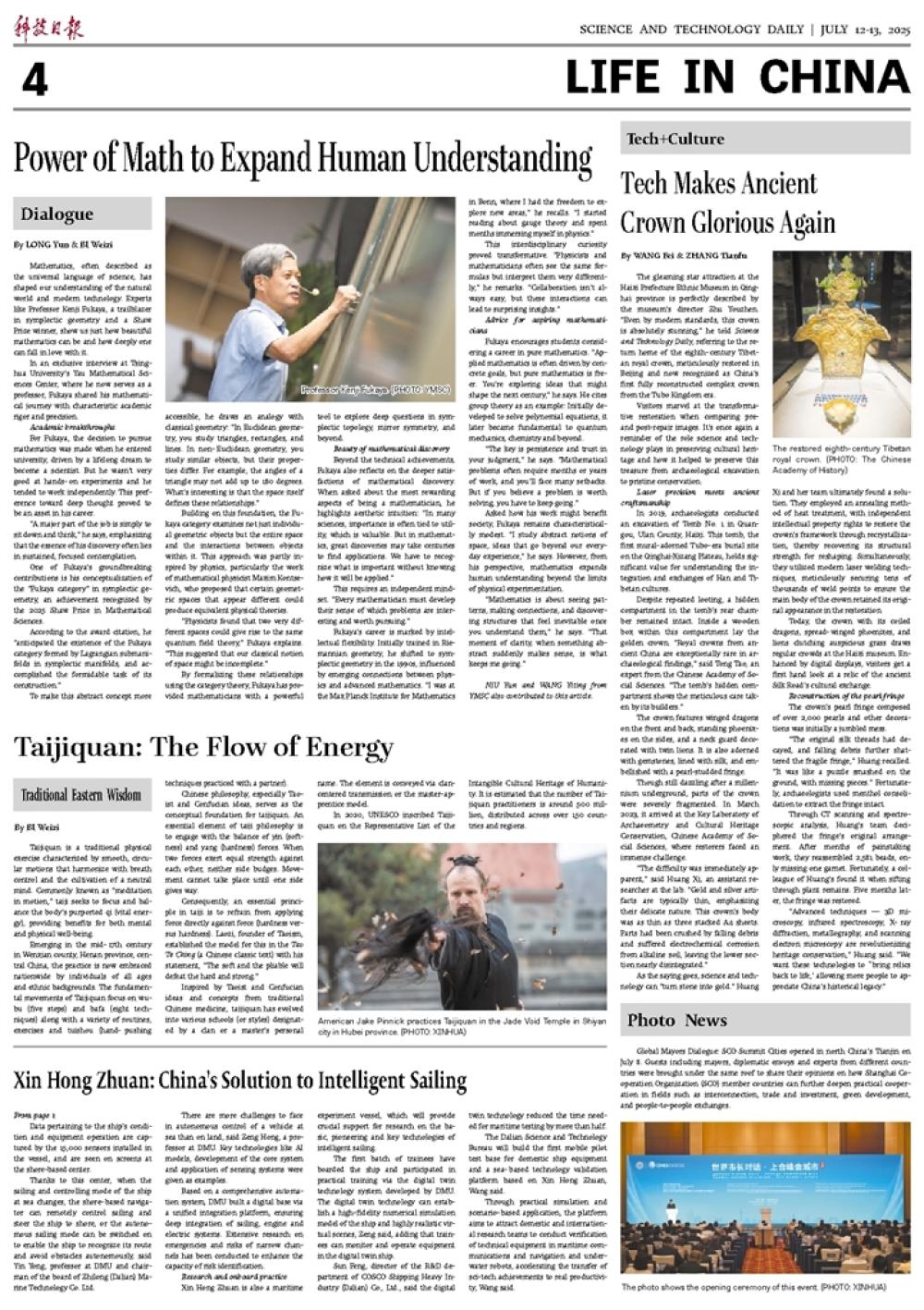
| American Jake Pinnick practices Taijiquan in the Jade Void Temple in Shiyan city in Hubei province. (PHOTO: XINHUA) |
Taijiquan is a traditional physical exercise characterized by smooth, circular motions that harmonize with breath control and the cultivation of a neutral mind. Commonly known as "meditation in motion," taiji seeks to focus and balance the body's purported qi (vital energy), providing benefits for both mental and physical well-being.
Emerging in the mid-17th century in Wenxian county, Henan province, central China, the practice is now embraced nationwide by individuals of all ages and ethnic backgrounds. The fundamental movements of Taijiquan focus on wubu (five steps) and bafa (eight techniques) along with a variety of routines, exercises and tuishou (hand-pushing techniques practiced with a partner).
Chinese philosophy, especially Taoist and Confucian ideas, serves as the conceptual foundation for taijiquan. An essential element of taiji philosophy is to engage with the balance of yin (softness) and yang (hardness) forces. When two forces exert equal strength against each other, neither side budges. Movement cannot take place until one side gives way.
Consequently, an essential principle in taiji is to refrain from applying force directly against force (hardness versus hardness). Laozi, founder of Taoism, established the model for this in the Tao Te Ching (a Chinese classic text) with his statement, "The soft and the pliable will defeat the hard and strong."
Inspired by Taoist and Confucian ideas and concepts from traditional Chinese medicine, taijiquan has evolved into various schools (or styles) designated by a clan or a master's personal name. The element is conveyed via clan-centered transmission or the master-apprentice model.
In 2020, UNESCO inscribed Taijiquan on the Representative List of the Intangible Cultural Heritage of Humanity. It is estimated that the number of Taijiquan practitioners is around 500 million, distributed across over 150 countries and regions.