


 |
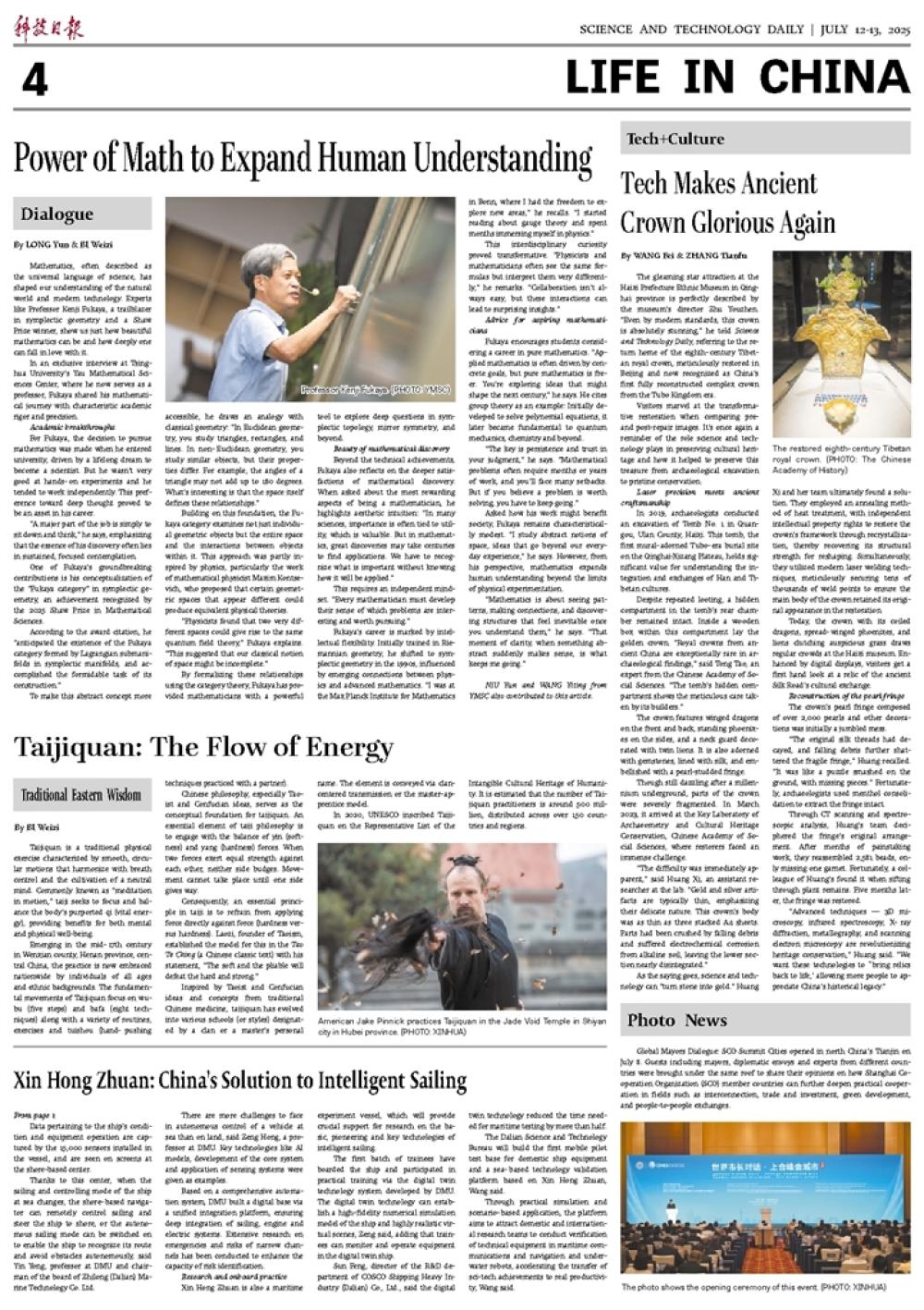
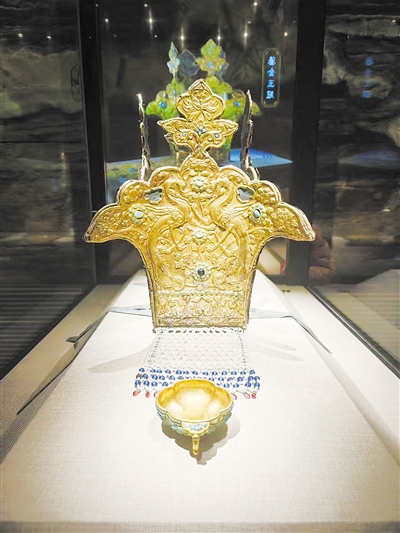
| The restored eighth-century Tibetan royal crown. (PHOTO: The Chinese Academy of History) |
The gleaming star attraction at the Haixi Prefecture Ethnic Museum in Qinghai province is perfectly described by the museum's director Zhu Youzhen. "Even by modern standards, this crown is absolutely stunning," he told Science and Technology Daily, referring to the return home of the eighth-century Tibetan royal crown, meticulously restored in Beijing and now recognized as China's first fully reconstructed complex crown from the Tubo Kingdom era.
Visitors marvel at the transformative restoration when comparing pre- and post-repair images. It's once again a reminder of the role science and technology plays in preserving cultural heritage and how it helped to preserve this treasure from archaeological excavation to pristine conservation.
Laser precision meets ancient craftsmanship
In 2019, archaeologists conducted an excavation of Tomb No. 1 in Quangou, Ulan County, Haixi. This tomb, the first mural-adorned Tubo-era burial site on the Qinghai-Xizang Plateau, holds significant value for understanding the integration and exchanges of Han and Tibetan cultures.
Despite repeated looting, a hidden compartment in the tomb's rear chamber remained intact. Inside a wooden box within this compartment lay the golden crown. "Royal crowns from ancient China are exceptionally rare in archaeological findings," said Tong Tao, an expert from the Chinese Academy of Social Sciences. "The tomb's hidden compartment shows the meticulous care taken by its builders."
The crown features winged dragons on the front and back, standing phoenixes on the sides, and a neck guard decorated with twin lions. It is also adorned with gemstones, lined with silk, and embellished with a pearl-studded fringe.
Though still dazzling after a millennium underground, parts of the crown were severely fragmented. In March 2023, it arrived at the Key Laboratory of Archaeometry and Cultural Heritage Conservation, Chinese Academy of Social Sciences, where restorers faced an immense challenge.
"The difficulty was immediately apparent," said Huang Xi, an assistant researcher at the lab. "Gold and silver artifacts are typically thin, emphasizing their delicate nature. This crown's body was as thin as three stacked A4 sheets. Parts had been crushed by falling debris and suffered electrochemical corrosion from alkaline soil, leaving the lower section nearly disintegrated."
As the saying goes, science and technology can "turn stone into gold." Huang Xi and her team ultimately found a solution. They employed an annealing method of heat treatment, with independent intellectual property rights to restore the crown's framework through recrystallization, thereby recovering its structural strength for reshaping. Simultaneously, they utilized modern laser welding techniques, meticulously securing tens of thousands of weld points to ensure the main body of the crown retained its original appearance in the restoration
Today, the crown with its coiled dragons, spread-winged phoenixes, and lions clutching auspicious grass draws regular crowds at the Haixi museum. Enhanced by digital displays, visitors get a first hand look at a relic of the ancient Silk Road's cultural exchange.
Reconstruction of the pearl fringe
The crown's pearl fringe composed of over 2,000 pearls and other decorations was initially a jumbled mess.
"The original silk threads had decayed, and falling debris further shattered the fragile fringe," Huang recalled. "It was like a puzzle smashed on the ground, with missing pieces." Fortunately, archaeologists used menthol consolidation to extract the fringe intact.
Through CT scanning and spectroscopic analysis, Huang's team deciphered the fringe's original arrangement. After months of painstaking work, they reassembled 2,581 beads, only missing one garnet. Fortunately, a colleague of Huang's found it when sifting through plant remains. Five months later, the fringe was restored.
"Advanced techniques — 3D microscopy, infrared spectroscopy, X-ray diffraction, metallography, and scanning electron microscopy are revolutionizing heritage conservation," Huang said. "We want these technologies to ‘bring relics back to life,' allowing more people to appreciate China's historical legacy."