

 Next
Next


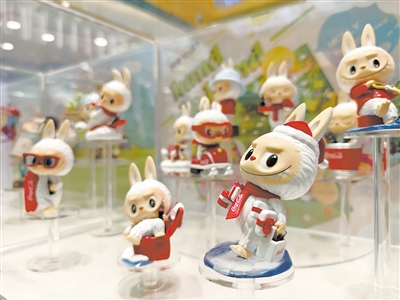 |
| Labubu toys are exhibited at Beijing's APM shopping center on June 18, 2025. (PHOTO: VCG) |
Before 5 a.m., a snaking queue of hundreds of people had formed outside a store in Los Angeles on April 25. Some even started queuing at 10 p.m. the previous night. What they were waiting for all night was not a new iPhone or a luxury good but a Chinese creation — Labubu.
Fans around the world are scrambling to purchase it, and celebrities in Europe and America are showing off their collections of it. Labubu, a collectible based on artist Kasing Lung's eponymous storybook character, a goblin with nine sharp teeth and a wide grin, has become a global top star.
Why has Labubu become so popular worldwide?
The craze for Labubu shows the huge potential of emotional consumption and the power of cultural resonance. The key lies in understanding the core demands of global consumers amid changes.
Labubu's popularity is proof of the importance of providing emotional value to global consumers. This kind of emotional consumption, made solely for the consumer's own pleasure and satisfaction, is the reconstruction of the fairy tale world after growing up, as well as the pursuit of self-personalized expression.
Technology has also contributed to the craze by speeding up the creation process. Some Chinese enterprises have reduced the time to develop the molds for original toys from 50 days to 10 days by using digital modeling. Other intelligent manufacturing technologies have increased production capacity by five to 10 times compared to the past.
Culture endows intellectual property (IP) with soul. In recent years, Chinese companies have not only delved deeply into the excellent traditional culture, promoting a series of national products that have gone viral, but have also won the favor of global consumers with their creativity and emotional connection.
Labubu is not merely a trendy toy IP. It is a microcosm of the emotions of young people, a symbol of contemporary popular culture, and a vanguard of Chinese brands going global.
Chinese IPs are no longer presenting simple images. Instead, they are employing more diverse narrative strategies and cultural integration to offer emotional resonance and value recognition to young people around the world.
Dongguan in Guangdong province, south China, is an example of that. In 2023, the output value of original IPs created in the industrial city surpassed that of its traditional contract manufacturing business for the first time, indicating the shift towards higher-value, innovation-driven industries.
Labubu is not the only Chinese story of such innovation success. The blockbuster Chinese film Ne Zha 2 is another example, so is the Chinese video game Black Myth: Wukong. In all these cases, the original IP content has been honed by intensive time and effort.
It took five and a half years to make Ne Zha 2, with over 4,000 people involved in its production and nearly 2,000 special effect shots. It took over six years to develop Black Myth: Wukong, incorporating a vast amount of artistic resources to ensure top-quality performance for players worldwide.
Innovation has become a distinct quality of Chinese brands, and Chinese innovators in various fields are becoming an important force in the field of global culture.