

 Next
Next


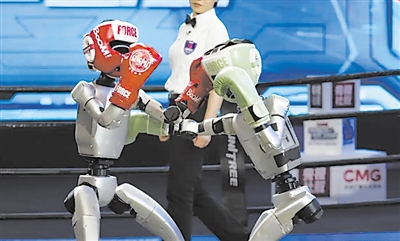 |
| China hosts the world's first humanoid robotics boxing competition and live streams it on the Internet in late May. (PHOTO: CMG) |
Audiences in Hangzhou, Zhejiang province, were given a taste of mechanical pugilist prowess in late May, when four Unitree G1 humanoid robots competed in the first-ever humanoid robot boxing tournament. The event was seen as a real-world "Real Steel" encounter, and it raised awareness of China's robotic advancements in the technical and industrial domains, while also garnering international attention for its display of mechanical agility and resilience.
Different levels of coverage were given by internationally well-known media, such as the BBC, CNBC, DW, and The Telegraph.
Some media heaped praised on China's humanoid robot development. The Asia Times sparked a new debate in an article called "Unitree vs Boston Dynamics," while Japan's ANN Television described it as a demonstration of China's technological expertise.
On TikTok, videos of the humanoid robot fights have gone viral, with media posts receiving tens of thousands of likes.
However, detractors are never far off. In a streamed broadcast, Bloomberg's host was heard mocking the fighting robots, which annoyed many viewers. One comment said, "A man on horseback laughs at the first automobile rally in 1920," receiving widespread approval. Another popular comment suggested that the Bloomberg host wouldn't be laughing in five years time.
The commentary soon shifted to a debate on the potential application of technology. Suggestions ranged from assistive devices for people with disabilities to concerns about machines replacing human labor. However, one viewpoint was generally accepted and that was today's seemingly novel ideas may become tomorrow's mainstream.
In fact, this sequence of "amazement, skepticism, and caution" precisely encapsulates the disruptive nature of the current technological revolution.
As numerous international observers have noted, when science fiction-like scenarios begin to materialize, excitement is invariably tempered by apprehension. This duality epitomizes our era — defined by rapid technological advancement.
Deploying humanoid robots in high-intensity, multi-variable combat scenarios serves as a real-world test of their capabilities. Compared to static demonstrations or pre-programmed tasks, putting bots in the ring unlocks what these machines can really do, including dynamic balance, environmental awareness, real-time decision-making, and harmonized operation.
Each fall and instance of instability exposes technical deficiencies — providing clear directives for improvement in both software algorithms and hardware design. These extreme trials not only accelerate innovation but also propel engineering capabilities to unprecedented levels.
In this sense, robotic combat transcends mere entertainment; it constitutes a serious technical proving ground. It reflects China's growing momentum in the industrialization of humanoid robotics — a process characterized by continuous experimentation and rapid iteration.
Significantly, China believes the proof is in the pudding, and criticism will improve products. China is accelerating the industrialization of humanoid robots by leveraging "extreme sports" as a testing platform. From marathon courses to combat arenas, robots are continuously pushing limits in demanding scenarios.
Furthermore, the first World Humanoid Robot Games, scheduled for Beijing this August, is poised to further test China's robot technology. It has been announced that another Chinese humanoid company Engine AI will compete in another robot boxing match at the end of 2025.
According to official projections, China's humanoid robot output is expected to surpass 10,000 units in 2025. The domestic market is expected to reach 8.24 billion RMB, grabbing nearly half of the global share. In the same year, the embodied AI market in China is projected to reach a value of 5.30 billion RMB. The timer for achieving these technological benefits has essentially started.
As metallic limbs clash in the ring, they simultaneously knock on the door of the future. In this unfolding era of human-machine collaboration, the true victors will be those societies bold enough to envision and embrace the transformation ahead.