

 Next
Next


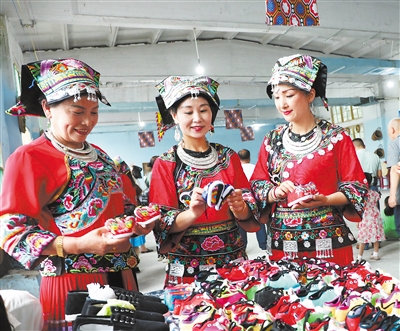 |
| Intangible cultural heritage artists show the Miao embroidery in Xiangxi, Hunan province. (PHOTO: VCG) |
On a misty summer morning in Fenghuang county, feminine laughter and chatter of the local guesthouse owners and servers echo along the cobblestone streets.
These women, from Xiangxi Tujia and Miao autonomous prefecture, central China's Hunan province, once confined to traditional roles, now livestream their exquisite Miao embroidery crafts, edit travel vlogs on smartphones, and manage digital orders with just a few taps — a clear sign of technology transforming rural life.
"Before, I only worked by the stove. Now, I work in front of screens!" said Zhang Gengxin, a guesthouse owner in Pingjiang county, Hunan province. By posting short videos, she popularized her family's guesthouse and helped nearby villagers increase their income by selling regional specialties — dried vegetables alone bring in over 6,000 RMB monthly.
Zhang's story exemplifies the "Digital Mulan" training program (Mulan is a legendary figure in Chinese history, known for her braveness and courage), initiated by the Ministry of Culture and Tourism, China Rural Development Foundation, and others.
This project offers rural women working in guesthouse services skill and digital literacy training. By the end of 2024, it had reached over 6,600 women, across 16 provinces, with tiered courses: foundational classes on etiquette and safety, advanced sessions on short video editing and livestream marketing, and elite trainees gaining experience at star-rated hotels.
"When we invest in women's access to science and technology in rural communities, the benefits ripple across entire societies," Siddharth Chatterjee, UN resident coordinator in China, said in a video speech during an event focusing on how sci-tech is empowering rural women in Fenghuang. "China's rural e-commerce villages, women-led agritech cooperatives, and digital literacy campaigns, offer models the world can follow," he said.
At a guesthouse in Fenghuang, Wu Jinhua uses newly learned editing software to create compelling room service videos. A former embroidery worker supporting her family, Wu now serves as a cultural ambassador for the guesthouse, skillfully telling stories through video narratives. Liu Yu, a mother of two, shifted from working as a salesperson to becoming a short-video influencer, drawing visitors with stunning cliffside views at the Lahao Forest Guesthouse.
"Stoves and fields shouldn't define rural women's entire lives. Low education should never be a chain; learning new skills unleashes the power to grow upward," Liu said passionately.
Women's pioneering roles aren't confined to tourism. Wang Min, a female drone operator in Anhui province, manages crop protection over 100,000 mu (over 6666.7 hectares) using drones and BeiDou satellite navigation, vastly boosting rapeseed farming efficiency. In Guangxi Zhuang autonomous region, sugarcane farmer Wei Shuixiu promotes full mechanization of cane cultivation, increasing income by 500 RMB per mu and inspiring surrounding smallholders to modernize.
"When digital technology meets women's creativity, it transcends geographical and gender boundaries. China's experiences in driving equity through innovation offer valuable lessons for the world," said Gao Anming, editor-in-chief of the China International Communications Group.
World Bank statistics show empowering women can raise farm yields by 20 to 30 percent. China's examples prove this theory in practice: experts from Nanjing Agricultural University introduced grafting techniques in Kenya, helping female demonstration farmers boost annual incomes by over 16,600 RMB; while in Hunan, a 173 million USD project by the International Fund for Agricultural Development (IFAD) targets inclusive rural development, commercial service systems and farmer training — benefiting 328,000 people, half of whom were women.
Providing rural women with the resources they need is pivotal in driving their transformational growth, leading to inclusive rural revitalization, said Nii Quaye-Kumah, representative of the IFAD in China and head of the Asia and the Pacific Regional Center for South-South and Triangular Cooperation.
Through South-South cooperation, Chinese practices are contributing to global poverty alleviation efforts, illuminating the path toward a more equal and prosperous rural future.