


 |
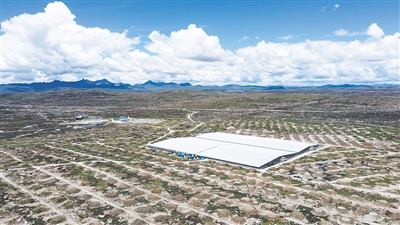
| Aerial photo shows the construction site of the Large High Altitude Air Shower Observatory. (PHOTO: XINHUA) |
The Large High Altitude Air Shower Observatory (LHAASO) is the world's highest altitude, largest scale, and most sensitive cosmic ray detection facility, representing a major national sci-tech infrastructure project in China. Construction of LHAASO commenced in July 2016 and passed acceptance inspection in May 2023.
Located at an altitude of 4410 meters on Mount Haizi in Daocheng county, southwestern China's Sichuan province, LHAASO spans approximately 1.36 square kilometers. Its core scientific objectives include exploring the origins of high-energy cosmic rays, studying cosmic evolution and high-energy astrophysical phenomena, and searching for dark matter.
As samples of matter beyond the solar system, cosmic rays and their origins provide critical pathways to unravel the universe's mysteries and its evolution. Since the discovery of cosmic rays in 1912, numerous explorations and studies have been conducted, yet their origin remains unresolved. LHAASO has been designed to address this major scientific puzzle.
LHAASO comprises an observation base and a control base. The observation base is situated on Mount Haizi at an average altitude of 4,410 meters, while the control base is located in Daocheng county's lower-altitude urban area. Compared to existing high-altitude stations, this site selection significantly improves field station working conditions, ensures the safety of researchers during long-term high-altitude operations, and facilitates international collaboration through accessible transportation.
Once formally operational, LHAASO will become a Chinese-led, multinational cosmic ray research centre. Leveraging its high altitude advantages in gamma ray astronomy and cosmic ray observations, the facility will serve as a distinctive, comprehensive, and open scientific research platform.