


 |
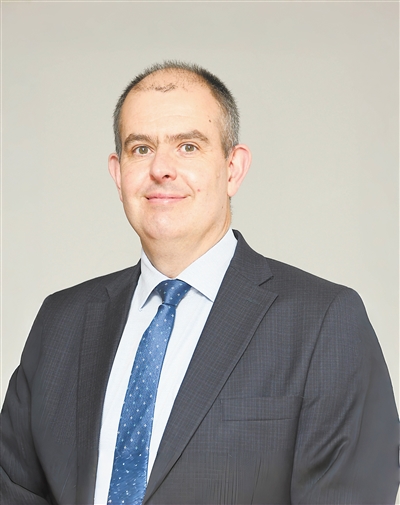
| Daan du Toit. (COURTESY PHOTO) |
Daan du Toit, deputy director general of International Cooperation and Resources at South Africa's Department of Science and Innovation, recently sat down with Science and Technology Daily (S&T Daily) to share his thoughts on South Africa's great strides in AI and its growing collaboration with China in the sci-tech field.
S&T Daily: What are some specific achievements made in AI development in South Africa?
Daan du Toit: We have made a number of investments in developing the digital skills, as well as infrastructure capabilities of South Africa, with a specific focus on AI. For example, we have a dedicated research network for AI, the South African Artificial Intelligence Research Network, which is hosted in Pretoria by the Council for Scientific and Industrial Research, and links several universities together. And we then look at how we apply AI and use AI in support of our government's economic and social development objective.
One then sees various applications, whether it's in the areas of education, health, drug development or using AI in frontier scientific disciplines such as astronomy.
Of course China is a world leader in AI. While we admire China's world leading status as an AI power, we are also building the blocks for a strong foundation, so South Africa can be a strong partner for partners such as China in AI.
S&T Daily: Recently, China's open source AI model DeepSeek has attracted world attention. Compared with some other AI apps developed by Western countries, what advantages does this have in terms of application in the Global South countries?
Daan du Toit: I think it was really an extraordinary achievement and again demonstrates China's status as a world leader in science, technology and innovation. We are following, with much admiration, the progress of DeepSeek. And I think it's remarkable and important for the Global South for three reasons.
First, DeepSeek showed what can be achieved very cost-effectively. It's much cheaper than many similar applications and large language models being developed elsewhere. And I think that is one of the big challenges of AI — to make it affordable. I think DeepSeek's affordability is rather remarkable. It means AI can become inclusive.
And of course, the cost is linked to the technology used, making it less power intensive. So it's also more environmentally friendly. What is also very significant is the fact that the source model is open to share. And that's why we know China believes in innovation to achieve progress and to benefit all.
I think that creates really great opportunities for scientists and innovators from the Global South to work with China.
S&T Daily: In what areas can China and South Africa further strengthen cooperation in sci-tech development? And are there any specific sectors or projects that stand out as priorities for both sides?
Daan du Toit: We have a long standing, very privileged partnership in science, technology and innovation between South Africa and China. And our two ministries, the Department of Science and Innovation and the Ministry of Science and Technology of China, co-fund several research projects every year.
For example, we have joint research centers looking at areas such as the sustainable use of mineral resources. We also have very strong collaboration in the area of space science and technology between the South African National Space Agency and its counterpart in China.
China is a very important partner for the Square Kilometer Array radio telescope, which is the world's largest telescope hosted in South Africa. Both sides are committed to further developing this collaboration.
Some of the new areas in which we are very keen to strengthen collaboration are clean energy, clean coal technology, the hydrogen economy, and AI.
We are looking at potentially establishing a South Africa-China joint research center in AI. We are also looking to intensify collaboration on the Beidou Navigation Satellite System.
Lastly, an area where South Africa can learn a lot from China, and one in which we are very eager to collaborate, is innovation for poverty alleviation. This is because we are in awe of the remarkable success China has achieved in fighting poverty through investment in science, technology and innovation. Therefore, we are privileged in this partnership to see what we can learn from China and apply some of those best practices to fight poverty in South Africa.
The author is a correspondent for S&T Daily based in South Africa.