


 |
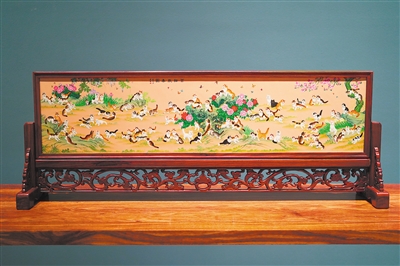
| A Pingyao's varnished lacquer product is on display at China Art & Crafts Museum in July, 2023. (PHOTO: VCG) |
The varnished lacquerwares in Pingyao go back to ancient times. It's said that they began in the Shang and Zhou dynasties (2000 BC), evolved throughout the Tang Dynasty, and reached their zenith during the Ming and Qing dynasties. The export of varnished lacquer goods to England, Russia, and Southeast Asia started in the middle of the Qing Dynasty. Pingyao varnished lacquerware reached a new level during the 1920s when a lacquerware craftsman by the name of Qiao Quanyu combined improved methods for producing varnished lacquerware with the glass painting style of south China.
The natural raw lacquer used to make Pingyao's varnished lacquer products is unique to China and is applied by hand using a unique method. The lacquerware is then embellished with patterns of mountains and lakes, flowers and birds, people and pavilions, through embedding, sculpting, carving, mosaics, and colored painting. Then, ornaments made of copper are installed to make the final products more elegant and sophisticated. With the final polishing, the surface of Pingyao varnished lacquerwares becomes glossy and smooth, therefore able to withstand heat, alkali, and acids. The longer it is polished, the brighter this piece of handicraft becomes.
In recent years, the creative scope of Pingyao lacquerware has extended to a diverse range of objects, such as exquisite jewelry boxes, cutlery, pendants, folding screens, furniture, and ornamental vases. The products are exported as far as West Europe, North America, Japan, Singapore and Malaysia.
Having a history of over 1,000 years, the Pingyao lacquerware was listed as one of the national intangible cultural heritages of China in 2006.