


 |
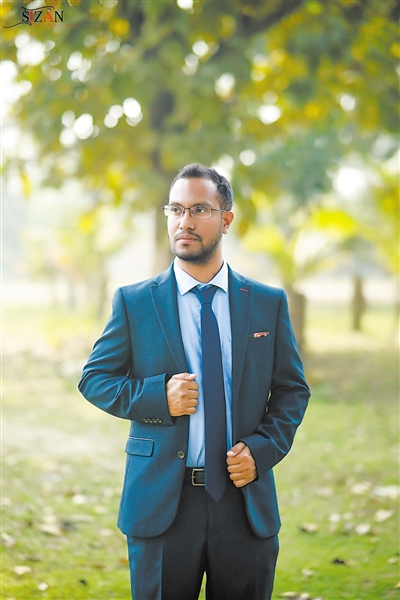
| Dr. Md Monjurul Karim. (COURTESY PHOTO) |
When Md Monjurul Karim first arrived in China in 2007, the country was in a transformative era. The Beijing Olympics were just around the corner, and the atmosphere was electric with anticipation. "It was an exciting time, and you could already feel the momentum of change," he recalled. For this young Bangladeshi, the Olympics wasn't just about sports. It was a symbol of China's technological and infrastructural transformation. Since then, Karim, a postdoctoral research fellow at the Shenzhen Institute of Advanced Technology (SIAT), Chinese Academy of Sciences, has witnessed firsthand how China has grown into a global leader in the sci-tech field.
From hosting the Shanghai World Expo in 2010, to launching major advancements in AI, 5G, and blockchain, the pace of development has been remarkable. "Living here through these changes has deeply influenced my own aspirations," he said. "Seeing how technology drives progress in China made me realize that I wanted to be part of this movement, contributing to cutting-edge research and developing solutions that make a real-world impact."
Karim's research focuses on areas like AI, decentralized finance, and blockchain technologies. His goal is to develop innovative solutions that enhance the security, scalability, and efficiency of digital ecosystems. China has provided him with numerous opportunities to grow as a researcher in software-defined networking and AI-related fields. "From day one, I felt welcomed into an environment that encourages curiosity and innovation," he said, adding that his academic journey in China has been about exploration and self-discovery.
"Throughout my bachelor's, master's, and PhD, I was always encouraged to push boundaries, think critically, and apply what I learned to real-world problems," he said. His professors and classmates were supportive, and this support continued into his postdoctoral research. "My current supervisor, Professor Qiang Qu, has been instrumental in guiding my research. We often have deep discussions, set goals together, and work collaboratively to achieve impactful research outcomes."
As a postdoctoral researcher at SIAT, Karim's focus has expanded into generative AI and decentralized systems. "China's rapid advancements in AI, from large language models to real-world applications in smart cities and decentralized finance, have given me access to incredible resources," he said. The continuous knowledge-sharing culture, including discussions with peers, insights from professors, and reading WeChat blog posts, keeps him at the forefront of the latest breakthroughs in AI.
Karim says that China is one of the best places for international students and researchers. He applauds the financial and institutional support that creates an inclusive and accessible environment for those pursuing higher education in a world-class setting. Beyond academics, the cultural experience in China has been unparalleled. "I've been here from my undergraduate days to my PhD, and in that time, I've gained not just knowledge but also a deep appreciation for the culture and the people," he said. "It's a place where you don't just study. You grow as a person, immersing yourself in a culture that balances innovation with tradition."
For Karim, living in China has not only enriched him academically and culturally, but also exposed him to some of the most advanced technological advancements in the world.
One of the country's major milestones was the rise of mobile payment systems. "When I first came here, people were still using cash, and now you can go an entire day without even carrying a wallet!" he said. Platforms like WeChat Pay and Alipay have completely revolutionized the way transactions work. Another incredible achievement is China's leading role in 5G technology. "The rollout of 5G networks happened at an unprecedented speed, making China one of the first countries to achieve widespread coverage," he said. From his perspective, the impact of this goes beyond just faster internet, as the advanced 5G technology is the backbone for smart cities, autonomous driving, and IoT infrastructure.
SIAT also contributed to this article.