


 |
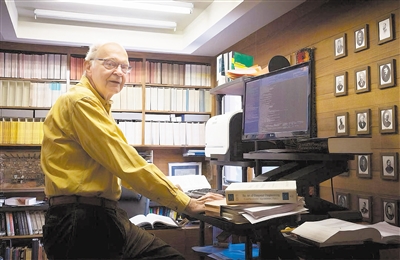
| Professor Donald Knuth. (COURTESY PHOTO) |
In the world of computer sciences, few books are held in as high esteem as The Art of Computer Programming (TAOCP), a multivolume masterpiece by Stanford professor emeritus Donald Knuth. It's the kind of book that prompted Bill Gates to say, "If you think you're a really good programmer, read [Knuth's] The Art of Computer Programming. You should definitely send me a résumé if you can read the whole thing."
But despite his contributions to computer science, Knuth, now 87 years old, still stays humble and down-to-earth and remains passionate about writing and sharing knowledge.
Origins of a legend
Born in the U.S., Knuth is often referred to as a "pioneer of modern computer science." His work introduced two core concepts that are fundamental to the field: algorithms and data structures. Beyond that, he invented TeX, the typesetting system that became a standard in academia, and Metafont, a font design system. His groundbreaking research and innovations have shaped the direction of theoretical computer science in profound ways.
Knuth's crowning achievement is undoubtedly the TAOCP, a series of volumes first published in 1968. Today, the books are considered a touchstone for anyone serious about understanding algorithms and programming languages. In fact, by the end of the 20th century, the TAOCP was named one of the "best 12 physical-science monographs of the century," alongside Principles of Quantum Mechanics by Dirac and Theory of Relativity by Einstein and other world-renowned masterpieces.
The work's impact was so profound, that it earned Knuth the prestigious Turing Award in 1974, making him the youngest recipient at just 36 years old, a record that still stands. However, he downplays his status as a pioneer. Reflecting on his journey, he said, "I have never thought of myself as a trailblazer. I prefer to see myself as a recorder of the development of algorithms."
Roots of TAOCP
The story behind the TAOCP is as fascinating as the work itself. Back in 1962, when Knuth was a young mathematics PhD student at Caltech, he was approached by a publisher to write a book on compilers. But as he began his research, Knuth quickly realized that computer science was still in its infancy, and the literature on the topic was sparse and of uneven quality.
Despite these challenges, Knuth was determined to create a comprehensive resource that would systematize the understanding of algorithms. His initial manuscript for TAOCP grew to an astounding 3,000 handwritten pages by 1965, and Knuth began to rethink the scope of the work, ultimately planning it as a seven-volume series.
Currently, three of those volumes have been published, with the fourth volume's first part "A," already available in Chinese. The English version of the fourth volume, part C, was published in 2024. However, Knuth admits that finishing the entire series may take longer than he anticipates. "This field is so exciting, and there's always something new happening. I don't know how long I'll live, but I'll write as much as I can."
Symphony to be continued
For Knuth, writing the book series has been a lifelong pursuit. Despite his fame and the vast recognition he's received, he remains dedicated to advancing the field.
Knuth's curiosity and critical thinking remain sharp. He is interested in the present state of AI and in the future scenarios it might bring.
In 2022, when OpenAI released its ChatGPT model, Knuth, ever curious about emerging technologies, tested the system with a series of tricky questions to see how it would handle them. His questions included "Will the Nasdaq index rise on Saturday?" (a question about a stock market that's closed on Saturdays) and "Write a sentence using exactly five letters." While impressed by the system's eloquent responses, Knuth noted, "ChatGPT is much better than 99 percent of the writing out there. But it also makes some surprising errors."
A lifetime of honors, and a humble heart
Throughout his illustrious career, Knuth has received numerous accolades, including the Grace Hopper Award, the National Medal of Science, and over 100 other prestigious honors. Despite all the recognition, he remains grounded. "I'm very grateful for all the honors, but I'm also a bit uneasy. I worry that people might start to think I'm an all-knowing figure, and that when I express an opinion, it might be taken as more authoritative than it really is," he explained.
He also shared an interesting anecdote: after receiving the Turing Award, Knuth didn't place the silver trophy on a pedestal like most recipients would. Instead, he used it as a bowl for strawberries and ice cream.
Knuth's approach to life is a reminder that even those with the greatest minds remain humble, always learning and always questioning. His relentless pursuit of knowledge reflects the very essence of what it means to be a lifelong learner.
This article was edited based on the original version written by ZHANG Xinxin from Cover News based in Chengdu, Sichuan province.