


 |
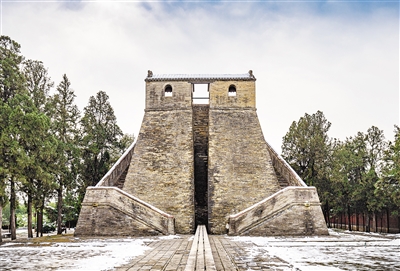
| The Dengfeng Observatory. (PHOTO: VCG) |
The Dengfeng Observatory in Dengfeng city, Henan province, central China, is the oldest surviving observatory in China for monitoring celestial phenomena. It is one of the oldest surviving observatories in the world as well. Built under the supervision of astronomer Guo Shoujing from 1276 to 1280, it has a long tradition of making astronomical observations throughout history.
As part of the "Historic Monuments of Dengfeng 'in the Center of Heaven and Earth'," the observatory was inscribed on the UNESCO World Heritage List in 2010.
It is a mixed brick and stone architecture, with the four walls tilted inward toward the center, a typical feature of early Chinese architecture.
The building has two parts, a platform and a stone sundial. On the 9.46 meters high platform, there are two small huts. To its north is a symmetrically arranged entrance and exit, connected to it by stairs and walkways.
There is a horizontal stone beam between the two huts. As the sun moves, the shadow of the beam falls on the sundial, and the length of the shadow at different times helps to trace the sun's movement.
The Dengfeng Observatory is the product of the interaction of science, religion and politics, and its unique design is proof of the highly developed astronomy of the Yuan Dynasty (1271-1368).