


 |
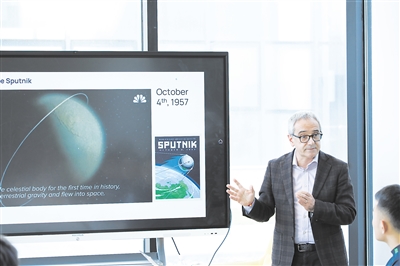
| Professor Antonio Capone. (COURTESY PHOTO) |
Recently, Italian professor Antonio Capone delivered a lecture titled "From the Moon to the Internet: A Journey Through History and Innovation" at Xi'an Jiaotong University (XJTU), which received widespread applause from the students. "I aimed to draw a parallel with how we must embrace the spirit of innovation across various fields today, and remain open to the unexpected transformations that research can bring," he told Science and Technology Daily, when explaining the inspiration behind his presentation.
As a full professor at Politecnico di Milano, where he serves as dean of the School of Industrial and Information Engineering and director of the Advanced Network Technologies Laboratory (ANTLab), Capone has spent decades researching networking and communication technologies and promoting the spirit of innovation.
Building smarter networks
Capone's research centers on making communication networks more efficient, adaptable and sustainable. His team is currently advancing mobile radio networks to function at high frequencies, which promises to unlock the potential of larger bandwidths. This work aims to deliver faster data speeds while reducing energy consumption and operational costs. "The transformations in network infrastructure today may be invisible to most users," he said, "but they are fundamentally reshaping how we connect, paving the way for future applications that will revolutionize user experiences."
Capone also highlighted key breakthroughs in the field, including advancements in fiber optics for faster data transmission, quantum communication technologies to enhance cybersecurity, and the development of new materials for processing terahertz signals. In urban areas, innovations such as smart propagation environments are improving coverage and connectivity, even in densely populated settings. While optimistic about the future, Capone acknowledged the challenges of balancing rapid technological progress with sustainability goals.
International collaboration
Capone's first encounter with China was in 2011, when he joined an international collaboration aimed at developing energy-efficient communication technologies. Since then, his ties with Chinese institutions have significantly deepened in academia and industry. "Science and technology should be independent of conflict and geopolitical tensions," he stressed, adding that global collaboration benefits humanity and fosters shared progress.
As dean at Politecnico di Milano, Capone facilitates agreements with Chinese universities, enabling students to earn dual degrees and participate in exchange programs. These initiatives have equipped students with global perspectives and practical experiences. He described these collaborations as enriching for both sides, fostering cultural and academic exchange.
Reflecting on his teaching experience at XJTU, Capone expressed admiration for China's rapid digital transformation." China has shown what is possible when technology reaches almost the entire population in such a short time," he said.
"China is undoubtedly a global leader in communications and networking technologies," he said, noting the competitiveness of Chinese companies and their significant contributions to global research. According to Capone, Chinese researchers are consistently present at top international conferences and in journals, delivering groundbreaking work that pushes the boundaries of the discipline. Capone has forged industry partnerships with Chinese institutions, which have led to innovative patents and advancements in networking technologies.
A call to adapt and innovate
As an educator, Capone is passionate about preparing students for the rapidly evolving tech industry. He believes that universities should go beyond teaching technical skills, focusing instead on cultivating adaptability, curiosity and a lifelong passion for learning. He advocates for innovation in teaching methods, suggesting that educators should inspire students by demonstrating how a love for technology drives discovery and innovation.
Capone also emphasized the importance of multidisciplinary education in fostering creativity and problem-solving. According to him, while some students should specialize in technical fields, others should be trained to bridge disciplines and work collaboratively in teams. "Society needs a balance of specialists and creative thinkers who can connect different fields," he said, adding that, "This approach is critical for addressing the complexities of the modern workforce."
For young researchers and engineers, he encourages them to view networking and communication technologies, not just as a technical domain but also as a transformative field with the power to shape society. He urges young professionals to remain adaptable, embrace interdisciplinary approaches, and stay mindful of the social impact of their work.
"Networking technologies are at the core of modern life, powering everything from global connectivity to smart cities and autonomous vehicles," he said, adding that, "solutions you create in this field have the potential to address global challenges, reduce inequalities, and improve lives. Approach your career with purpose, knowing that your work can help build a better, more connected world."
LEI Yanjun and HAO Liu from XJTU also contributed to this article.