

 Next
Next


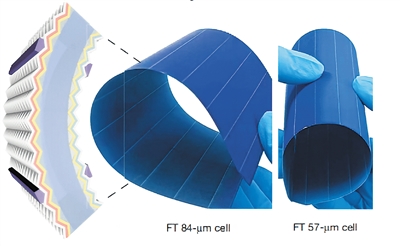 |
| Flexible silicon solar cells with high power-to-weight ratios. (PHOTO: LONGI) |
A crystalline silicon heterojunction solar cell that is paper thin, more flexible, and more efficient, has been manufactured by researchers from Jiangsu University of Science and Technology and Australia's Curtin University in collaboration with LONGI, a green energy company.
The thickness of such silicon cells is currently generally 150 μm to 180 μm, which makes them difficult to apply to scenarios requiring flexibility or strict weight limits, such as curved roofs, floating solar panels or aerospace applications.
According to a paper published in Nature, a combined approach that can improve the power conversion efficiency of silicon heterojunction solar cells and render them flexible at the same time has been developed by scientists.
Notably, the 57 μm-thick solar cell stands out with a power-to-weight ratio of 1.9 watts per gram and a curvature radius of 19 mm, surpassing existing products by two to three times.
Now, we have reduced the thickness of silicon wafers to less than 100 μm, which is thinner than an A4 sheet of printing paper, making up for the major shortcomings of silicon cells, said the paper's first author Li Yang, adding that, in the future, the research team will continue to develop more flexible, lightweight, low-cost and highly efficient solar cells that can be as portable as film.