

 Next
Next


 |
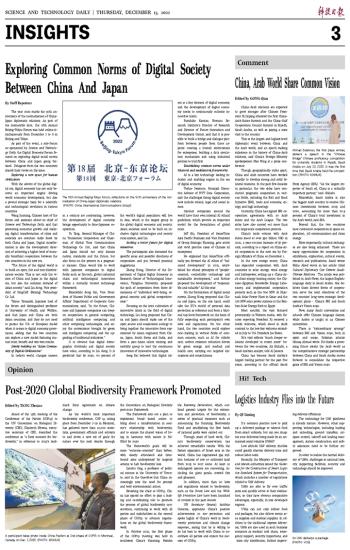
| A participant takes photo inside China Pavilion at 2nd phase of COP15 in Montreal,Canada, on Dec. 7, 2022. (PHOTO: XINHUA) |
Ahead of the 15th meeting of the Conference of the Parties (COP15) to the UN Convention on Biological Diversity (CBD), Elizabeth Mrema, executive secretary of CBD, described the conference as "a Paris moment for biodiversity," in reference to 2015's landmark Paris Agreement on climate change.
As the world's most important biodiversity conference, COP 15, taking place from December 7-19 in Montreal, has gathered more than 10,000 scientists, government officials and activists to nail down a new set of goals for nature over the next decade through the Convention on Biological Diversity post-2020 Framework.
The framework sets out a plan to implement broad-based action to bring about a transformation in society's relationship with biodiversity, and to ensure the shared vision of living in harmony with nature is fulfilled by 2050.
The framework's goals will be more "outcome-oriented" than before, with clearly articulated and time-bound aims underpinned by targeted actions to halt biodiversity loss.
Lynette Ong, a professor of political science at the University of Toronto, said in the Guardian that China increasingly sees the need for prompt and bold environmental action.
Retaining the chair at COP15, China has spared no effort to play a leading and coordinating role to promote the process of global biodiversity conservation, continuing to work with all parties and stakeholders in the second phase of COP15 to advance negotiations on the global biodiversity framework.
In October 2021, the first phase of the COP15 meeting was held in southwest China's Kunming. Besides the Kunming Declaration, which outlined general targets for the restoration and protection of biodiversity, a series of practical measures such as announcing the Kunming Biodiversity Fund and establishing the first batch of national parks were carried out.
Through years of hard work, China's biodiversity conservation has achieved remarkable results. With the fastest expansion of forest area in the world, China has regenerated 334 million hectares of raw or cultivated land from 2013 to 2017 alone. At least 10 endangered species are recovering, including the giant panda, crested ibis and pheasant.
In addition, more than 20 laws and regulations related to biodiversity, such as the Forest Law and the Wildlife Protection Law have been launched or revised in the past decade.
UN Secretary-General António Guterres, appreciate China's positive achievements in eco-protection and spoke highly of China's work in biodiversity protection and climate change response,saying that he is willing to do his best to work with China to coordinate all parties and ensure the success of COP15.
Opinion