

 Next
Next


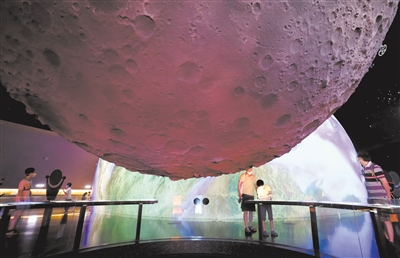 |
| Shanghai Astronomy Museum, which covers an area of approximately 58,600 square meters, is located at the Lin'gang Special Area of China (Shanghai) Pilot Free Trade Zone. (PHOTO: XINHUA) |
Since the 18th National Congress of the Communist Party of China, great strides have been made in popularizing science in the country. Currently, China has shifted to a stage of high-quality development, and boasts many advantages and conditions for continued development.
These include institutional advantages, improved governance efficiency, long-term economic momentum, and overall social stability. However, the tasks for reform in some fields remain arduous, and the current innovation capacity doesn't match the requirement for high-quality development.
In order to facilitate innovation through science popularization across society, the Guideline on Further Strengthening the Popularization of Science and Technology in the New Era was released by the General Office of the Communist Party of China Central Committee and the State Council on September 4, setting specific targets and measures.
According to the guideline, the function of science popularization to boost sci-tech innovation will see a notable improvement, and more than 15 percent of citizens will be science literate by 2025.
The guideline stresses strengthening the responsibility of the whole society in the quest to increase public science knowledge. Enterprises, research institutions, public organizations, sci-tech workers and individuals are all included in this process.
International cooperation on science popularization is highlighted. China plans to build platforms for cross-regional cooperation and promote joint construction and sharing of high-quality resources, said the guideline. Meanwhile, the country would join or take the lead in establishing international science popularization organizations and hold activities to strengthen exchanges in key fields.
Wang Zhigang, minister of science and technology, elaborated on the importance of the necessity of science popularization exchanges. He said the international environment is increasingly complicated, while the world pattern in economy, science and technology, culture, security and politics is seeing a profound adjustment, most notably from the impact of the COVID-19 pandemic.
To address global issues such as climate change, energy resources and public health, Wang said it is urgent to reach an international consensus on sci-tech governance. This requires science popularization to better play the role of a bridge to deepen the technological and cultural exchanges, and promote mutual learning of advanced experience among countries. He added that China would share research achievements with the world, and make more contributions to tackling common challenges.
The new round of sci-tech revolution and industrial revolution is advancing rapidly, and the social function of science and the relation between science and liberal arts has changed greatly.
Under these circumstances, Wang said that science popularization is needed to promote mutual integration between science and individuals, economy, society and culture, and build an atmosphere that advocates science, reason, civilization, and harmony, which will serve the modernization of national governance, and promote all-round human development and social progress.
For the balanced development between sci-tech innovation and science popularization, the key direction of national sci-tech development and sci-tech policies should be communicated to the public through science popularization, so as to guide society to understand and support innovation, and create a favorable atmosphere for scientific research and technological application, said Wang.