

 Next
Next
 Integrated Innovation Gains Momentum in Yangtze River Delta
- Rural Revitalization Flourishing Through Sci-tech Backyards
- Shanghai's Green Industries Make Impressive Advances
- BRI Project Promotes Industrial Upgrade in Indonesia
- Hi-tech Zones Driving China's Economic Growth
- 2022 CIFTIS Stimulates Greener Future


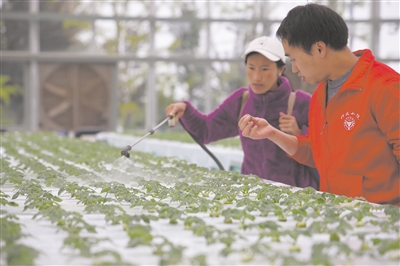 |
| A potato sci-tech backyard in Butuo county, Sichuan province. (PHOTO: XINHUA) |
More sci-tech backyards will be set up and supported in China's rural areas as part of efforts to empower smallholder farmers.
Sci-tech backyards are an innovative approach to integrate scientific research, social service and talent training.
In the backyards, agricultural professors, graduate students and extension workers will live and work together with smallholder farmers.
Statistics show that more than 300 such backyards have been established, with the support of over 30 agriculture related universities, covering a wide range of sectors such as grain crops, cash crops, medicinal crops, pasture crops, breeding, forestry and food processing.
During 2009-2020, 113 sets of technical procedures were set up, 284 innovative technologies were introduced, and more than 200,000 farmers received training through this model.
Now, the number of such backyards on the support list will expand to 780, according to a notification recently released by three government bodies, including the Ministry of Education (MOE).
They will be supported by 68 universities and institutes, including China Agricultural University, Chinese Academy of Agricultural Sciences, and Zhejiang University.
"I always hold the belief that I should go to rural areas, and go to the first site to solve issues," said Zhang Fusuo, academician of Chinese Academy of Engineering.
In 2019, Zhang, along with his colleagues and students, established the country's first sci-tech backyard in Quzhou county, Hebei province.
Since then, he and his team spend about 200 days every year in sci-tech backyards to do R&D, and transfer knowledge and skills to farmers.
Sci-tech backyards have seen substantial outcomes in providing expertise and intelligence services for farmers, said an official from MOE, adding that more support will be given to these backyards, particularly in less-developed counties.