

 Next
Next
 Integrated Innovation Gains Momentum in Yangtze River Delta
- Rural Revitalization Flourishing Through Sci-tech Backyards
- Shanghai's Green Industries Make Impressive Advances
- BRI Project Promotes Industrial Upgrade in Indonesia
- Hi-tech Zones Driving China's Economic Growth
- 2022 CIFTIS Stimulates Greener Future


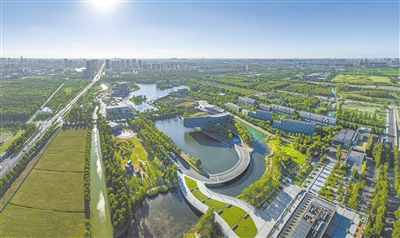 |
| Part of the Yangtze River Delta G60 Sci-tech Innovation Valley in Songjiang district, Shanghai. (PHOTO: VCG) |
A host of new policy documents have been unveiled to advance integrated development of sci-tech innovation in the Yangtze River Delta region, which includes Shanghai municipality and neighboring Zhejiang, Jiangsu and Anhui provinces.
During the 2022 Pujiang Innovation Forum, the Office for Yangtze River Delta Sci-Tech Innovation Community held its first meeting on August 27, and released three documents for the community to further draw upon each other's complementary advantages and achieve coordinated industrial and technological innovation.
The building of the Yangtze River Delta Sci-Tech Innovation Community is an important part of the country's endeavor to realize sci-tech self-reliance and self-strengthening. This community should explore more possibilities of sci-tech innovation for the whole country to replicate, said Wang Zhigang, minister of science and technology, during the meeting.
One of the documents, the Cooperation Mechanism for Joint Research of Yangtze River Delta Sci-Tech Innovation Community, aims to promote the establishment of a coordinated organizational mechanism between the Ministry of Science and Technology and municipal governments in the region, an integrated industrial innovation implementation system, as well as a multi-party investment mechanism.
Under the cooperation framework, the sci-tech departments in the delta region have selected 20 enterprises engaged in integrated circuits and artificial intelligence, and published a list of their urgent innovated projects.
More than 700 million RMB will be invested into these projects. Experts and teams from home and abroad can search and apply for projects via the cloud platform for integrated sci-tech innovation in the Yangtze River Delta region.
The Action Plan for Jointly Building the Yangtze River Delta Sci-Tech Innovation Community (2022-2025) puts forward the need to improve comprehensive innovation capacities of the delta region by 2025, development of a number of world-class industry clusters, and basic formation of the systems and mechanisms for integrated regional development.
The plan proposes five actions, including jointly cultivating national strategic sci-tech forces, promoting deeper integration of industrial and innovation chains, and building a coordinated global innovation network.
In addition, another document was released to promote the development of sci-tech innovation (STI) vouchers in the Yangtze River Delta.
In 2021, a pilot program was carried out for the STI vouchers to circulate in five areas of the Yangtze River Delta region, including the delta's Demonstration Zone for Integrated Ecological Development. It is expected that the STI vouchers will freely circulate in all areas of the delta region in two to three years.
Officially established in May 2021, the Office for Yangtze River Delta Sci-Tech Innovation Community has seen closer sci-tech cooperation in resource sharing and transfer of technological achievements.
The delta region now has more than 40,000 sets of major scientific equipment, and the sharing rate of the equipment exceeds 90 percent. The transfer and transformation of sci-tech achievements has become more active. In 2021, more than 21,000 technical contracts were signed in the delta region, and the transaction volume reached 87.7 billion RMB, up 38 percent year-on-year.